Leave a comment

Relationship Triad: Session 3

Leadership and Self-Deception: Getting Out of the Box, The Arbinger Institute

Session 3


Before You Meet

box close upI. Meditate 3-5 times on John 13:1-17 this week.

  1. Start with prayer for yourself and for others reading the same verse, that the same Spirit that inspired these words would open your heart and mind to them as well.
  2. Then read (often out loud) and reread, stopping to ponder particular phrases or words. Go back to the same 10-15 verses multiple times in the same week.
  3. Taking notes on what the Word is doing in you is often helpful. If stuck, you can think through questions of the text like does this challenge me? Convict me? Does it promise me anything? How does it point to Jesus?
  4. After chewing on the Word, close with prayer, often turning the same verses you are reading into a prayer back to God.


II. Read  Leadership and Self-Deception, Part III: “How to Get Out of the Box.”
Highlight and/or take notes for discussion. 


III. Watch the sermon “Life Under the Sign of the Cross,” below.
Write down some observations/reflections.


The Day You Meet

  1. Deeper Relationship building: Who were the people that sat around your dinner table growing up? What have your primary family relationships been like?
  2. Interact with the material: Based on your written notes, what was new; what did you question; how will you apply it?  Did you try to put this into action? How did that go?
  3. Prayer: Share one thing you are struggling with this week that could use some prayer support. Pray for each other and end with the Lord’s Prayer.
2 Comments

The Brazilian Metaphor LIFE IS A BATTLE

Editor’s Note

This article–the first by guest contributor Samuel Fuhrmann–is an excellent example of applying the metaphor theory proposed on this blog to both theology and culture. Samuel notices the way people talk (and think/evaluate/make decisions) in his Brazilian culture and uses these observations to think about how our theology can be preached and lived out in that particular context. As you read, notice how Samuel gets to the conclusions he makes. Pay special attention to the way he handles the inference structures in the metaphor. And enjoy a well-thought-out, well-written project on metaphor, theology, and culture!

–Justin Rossow

INTRODUCTION

Pastor, I need your help! I have been through great trials in life and not been able to overcome them. I know I have to „continue fighting‟ – I have to „fight‟ for the future of my family – but I just cannot see a way to overcome the difficulties and temptations I’ve been through.

This hypothetical plea for help from a parishioner to his or her pastor illustrates a common situation experienced by Brazilian pastors constantly. “To continue fighting” is a particular Brazilian expression, a metaphorical utterance, to say that life is not easy, that a person needs to overcome the bad things in life, even the person’s own weakness, in order to continue living and to achieve his or her goals in life.

In such a situation, in which a parishioner comes to his or her pastor and asks for help, comfort and strengthening, it would be better not to respond to such a plea by only saying this: This is how life is because of sin (meaning the original sin), but I have good news for you: Christ has died on the cross to forgive your sins; he has already gone through the worst difficulties for you! So, go in peace!

Although such a response would be theologically right, it might be incomplete or even out of context, for the parishioner, in the given case, would be talking about the Christian life while the pastor about salvation. If this is the only response to such a plea, then the parishioner might infer that he or she is alone to overcome the daily difficulties, or even that to overcome them is his or her part in the salvation process.
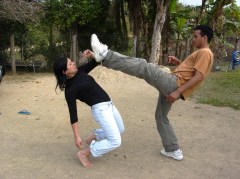
LIFE IS A BATTLE

Given this, the purpose of the present paper is to show how the Brazilian conceptual metaphor LIFE IS A BATTLE might render the proclamation of the Gospel in Brazil and how it can be useful for speaking of the Christian life. A description of how such a conceptual metaphor is identified will precede my attempt to propose a way of speaking of the Christian life to Brazilians. This description will be the first section of the present paper.

It is important to be clear on how we use battle imagery in our thinking and speaking, because confusion between narratives (salvation and the Christian life) might create also theological confusion. The present inquiry is therefore relevant not only for Brazilian pastors and theologians, but also for others who pay attention to the distinction between justification and sanctification.

A proposal for speaking of the Christian life to the Brazilian culture will be developed in the second section of the paper. This paper will require from its readers a basic prior knowledge of Metaphor Theory, which has been well explained by Justin Rossow in “Preaching the Story Behind the Image: A Narrative Approach to Metaphor for Preaching,”[1] as well as of the discoveries of George Lakoff and Mark Johnson in their book Metaphors We Live By, whose main idea is that “metaphor is pervasive in everyday life, not just in language but in thought and action.”[2]

“LIFE IS A BATTLE”
Identifying a Conceptual Metaphor in the Brazilian Culture

“Metaphor is a tool so ordinarily that we use it unconsciously and automatically, with so little effort that we hardly notice it.” [3]

In presenting a study about how people read poetry, George Lakoff and Mark Turner have shown that the metaphorical language used in poetry is not beyond ordinary language and that great poets use the same “tools” (like metaphor and metonymy) which we use in our daily conversations. The difference in using such tools resides in the fact that poets pay careful attention to and study them, while we use these tools “unconsciously and automatically,” as described in the above quotation.

This idea of metaphorical language as unconsciously and ordinarily used, which Lakoff and Turner have proven by presenting different metaphorical linguistic expressions in ordinary language, is also evidenced by a Brazilian way of speaking about life. Hardly noticing that they are using metaphorical language, Brazilians talk about their lives in terms of a battle, in which whoever wants to continue living should never stop fighting.

In their daily conversations there are many linguistic expressions in which fight, battle, struggle, victories and defeats serve as ways of describing a person’s view of or situation in life. According to Zoltán Kövecses in Metaphor in Culture: Universality and Variation, “metaphorical linguistic expressions make conceptual metaphors manifest.”[4]

The following list demonstrates some daily Brazilian linguistic expressions used when people talk about their ordinary lives. These expressions identify a conceptual metaphor for life in the Brazilian culture. Each expression in its original language (Portuguese) within the left column is followed by a translation into English within the column on the right side:

Linguistic Expression Translation
– A vida é feita de vitórias e derrotas  Life is made of victories and defeats
– Vai à luta!  Go ahead and fight for it!
– Não desista de lutar [5]
 Do not give up fighting
– A luta continua  The struggle continues
– Você tem que encarar as batalhas do dia a dia  You have to face the daily battles
– Este cara é batalhador  This guy is a fighter
– Não está morto quem peleia  Whoever still wrestles is not dead yet
– A morte venceu esta batalha  Death has won this battle
– Estou lutando por uma vida melhor  I am fighting for a better life
– Estou lutando pelo futuro da minha família  I am fighting for the future of my family
– Esta pessoa venceu na vida  This person has won in life

All these metaphorical linguistic expressions are possible because there is a metaphorical concept in Brazilian thought by which people process their understanding of life. According to Lakoff and Johnson, “The essence of metaphor is understanding and experiencing one kind of thing in terms of another.”[6]

In the present case, then, Brazilians understand and experience life in terms of a battle. And, on the basis of the above linguistic expressions, we are in a position to also affirm that LIFE IS A BATTLE is a conceptual metaphor in the Brazilian culture. Such a conclusion is based on, and thus has to be seen in light of, the cognitive linguistic approach to metaphor developed by Lakoff, Johnson and Turner. According to Rossow’s explanation of their approach, “metaphor is primarily a matter of thought and experience and only secondarily a matter of language.”[7]

This approach is helpful for the present paper because it allows us to think of the above metaphorical utterances in terms of correspondences between two conceptual domains which reside in people’s thought, and not only to think of words and their referents or signifiers and their signifieds. These are some correspondences between the two conceptual domains of life and battle:

  • A person leading a life is a fighter/ soldier. 
  • His purposes are survival, protection and a better life for his loved ones. 
  • The means for achieving purposes are hope and fight. 
  • Difficulties in life are enemies to be overcome. 
  • Counselors are commanders.
  • Plans are strategies. 
  • Professional success is victory.

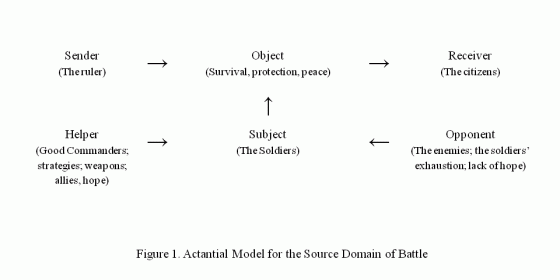
Another relevant aspect regarding metaphors is their connection with narrative contexts and their structures.[8] To say that a person fights for the future of his or her family, or that he or she should go ahead and fight for his or her goals in life, places this person within implied narrative relationships proper for a soldier, who has to fight for the best of his nation. Such relationships could be helpfully visualized by the use of the structuralist Actantial Model developed by A.J. Greimas,[9] as suggested by Rossow.[10] The narrative roles and relationships that shape the inference structure of the metaphor LIFE IS A BATTLE can be plotted on Greimas’ model (see below).
Presentation1

This is the implied narrative relationships of the Source Domain of the BATTLE metaphor put into Greimas’ Actantial Model. A second step to be taken here would be to map onto the Target Domain of  LIFE, on the basis of the correspondences of the two domains listed above. However, since the goal of the present paper is to provide a way of thinking of and experiencing not life itself, but the Christian life in terms of a battle, the mapping onto the target will be made in the second section, as we develop our proposal for speaking of the Christian life (see Part 2 or this blog).

What is important here is what the model helps to clarify, that is, the positions occupied in the narrative, the who is doing what for whom and how, to put it in Rossow’s words.[11] This way, the actantial positions in the model are helpful also for understanding and clarifying the distinction between the biblical narratives about salvation and the Christian life. For, in the salvation metaphors most central to Lutherans, “we/us” are always the Receivers and God the Subject; in a narrative about the Christian life, however, the Christian will sometimes be the Subject and God (Jesus or the Spirit) the Helper. This is what will be approached in the next section, as we map onto the target domain, attempting to suggest a way of speaking of the Christian life.  

See Part 2 of this blog, “The Christian Life if a Battle,” forthcoming.


Notes

[1] Justin Rossow, “Preaching the Story Behind the Image: A Narrative Approach to Metaphor for Preaching,” Ph. D. diss., Concordia Seminary, St. Louis (2009).

[2] George Lakoff & Mark Johnson, Metaphors We Live By, Chicago: The University of Chicago Press (2003), 3.

[3] George Lakoff & Mark Turner, More Than Cool Reason: A Field Guide to Poetic Metaphor, Chicago: University of Chicago Press ( 1989), xi.

[4] Zoltán Kövecses, Metaphor in Culture: Universality and Variation, Cambridge: Cambridge University Press (2005), 8.

[5] The word “luta” is the noun “fight”, while the term “lutar” is the verb “to fight”, in the infinitive form.

[6] Lakoff & Johnson, Metaphors We Live By, 5.

[7] Rossow, “Preaching the Story Behind the Image,” 254.

[8] Ibid., 34. Under the heading Narrative Approach to Metaphor, Rossow develops the second chapter of his dissertation by exploring the connection between narrative and metaphor. Although this connection had already been noticed by preachers and writers, it had not been deeply explored yet. Rossow provides an advanced study on the subject and shows the benefits of this connection for preaching (which neither preachers nor writers had done before).    

[9] Daniel Patte, “Structural Network in Narrative: The Good Samaritan,” Soundings 58 (1975), 229. According to Greimas’ structuralist model, it is assumed that every narrative has a structure which consists of a Subject communicating an Object to a Receiver. These three actants are also accompanied by a Sender (usually implied), a Helper (who helps the subject to deliver the object to the receiver) and the Opponent(s) (who try to hinder the delivery of the Object to the Receiver). These are the “actantial positions”; they form a basic structure that is found in every narrative, from a structuralist point of view.

[10] Rossow, “Preaching the Story Behind the Image,” 44. See footnote [7], above.

[11] Justin Rossow, “Preaching Metaphors We Live By,”  https://itunes.apple.com/us/itunes-u/preaching-metaphors-we-live/id468118579?i=117881938 (accessed on February 09, 2013).

Leave a comment

Relationship Triad: Session 2

Leadership and Self-Deception: Getting Out of the Box, The Arbinger Institute

Session 2


Before You Meet

box close upI. Meditate 3-5 times on Romans 7:15-25 this week.

  1. Start with prayer for yourself and for others reading the same verse, that the same Spirit that inspired these words would open your heart and mind to them as well.
  2. Then read (often out loud) and reread, stopping to ponder particular phrases or words. Go back to the same 10-15 verses multiple times in the same week.
  3. Taking notes on what the Word is doing in you is often helpful. If stuck, you can think through questions of the text like does this challenge me? Convict me? Does it promise me anything? How does it point to Jesus?
  4. After chewing on the Word, close with prayer, often turning the same verses you are reading into a prayer back to God.


II. Read the blog “Reading Guide: Leadership and Self-Deception” and write down some observations/reflections.

https://justinrossow.com/2012/05/09/leadership-and-self-deception-getting-out-of-the-box/


III. Read
 After you have one through the Reading Guide, read

Leadership and Self-Deception, Part I “Self-Deception and ‘The Box’” and Part II “How We Get In the Box;” highlight and/or take notes for discussion. 


The Day You Meet

  1. Basic relationship building: Name someone you like to be around and why. Name someone you don’t like to be around and why. (Did we mention confidentiality?)
  2. Interact with the material: based on your written notes, what was new to you; what did you question; is there something specific God wants you to hear or know or trust or change?  etc. Did you see any of this going on in your week?
  3. Prayer: Share one specific prayer request others can pray for you during this week. End with John Baillie’s prayer for the 9th morning.
2 Comments

Night Vision Goggles and Blended Spaces

One of my favorite Super Bowl ads is also a good example not only of metaphor theory in advertising, but of a phenomenon called “mental space blending.” Gilles Fauconnier and Mark Turner developed the theory of cognitive blending in their book The Way We Think: Conceptual Blending and the Mind’s Hidden Complexities For my money, I prefer the explanation in Bonnie Howe’s excellent Because You Bear This Name: Conceptual Metaphor and the Moral Meaning of 1 Peter. I would recommend either of those books; or, you can just watch the ad, below.


There is metaphor at work in this add, but there is also mental space blending going on. Before we can make the move to how happy Geico customers are (happier than antelope with night-vision goggles), we are presented with a fictive scenario in which antelope do things they would not “normally” be expected (or able) to do. What’s going on? From a blend theory perspective, we are reasoning and imagining from within a blended space, a combination of two distinctly different realities that combine to form a new, third thing that opens new possibilities.

Night-vision goggles can be worn by people (people who can also do other things, like talk, taunt opponents, etc.). Antelope are attacked by lions, sometimes at night. Combine these two “mental spaces”–basic scenarios and what we know about how they work–and you get the reality presented in the ad: antelope, hunted by  a lion, at night, with night-vision goggles, talking to each other and taunting their opponent. Couldn’t happen in reality, but in the blend we can easily imagine the kinds of things they would say.

This kind of blending occurs in our everyday experience all the time; so often, in fact, that we rarely notice it. Talking antelope is a little extreme, but any time you think through what could happen, or might have happened, or would happen if, you are using mental space blending to draw conclusions and set up expectations.

In the case of the Geico Super Bowl ad, the blend itself isn’t a metaphor; we aren’t thinking about hunting in terms of night-vision-enhanced warfare. Instead, we are asking to consider the good life of the antelope in the blended space and map that good life onto the domain of Geico customers. I know–it’s a bit of a stretch, and the Geico people know it, too, which is why the end is set up as a Vaudeville scene. This add has more to do with slap stick humor than marketing.

All the same, a metaphor is involved. In fact, this particular metaphor demonstrates an interesting wrinkle in metaphor theory: sometimes development is higher than the correspondence. DEVELOPMENT is simply how much is explicitly said in the metaphor; CORRESPONDENCE refers to how many or how few elements map from the source to the target domain (relatively).

Typically, the more that is said about a metaphor, the more things are intended to map. Sometimes, lots of stuff maps even though little explicit development is given. Even more rarely, the author or speaker goes on and on, even though very little actually maps from the source to the target.

This last situation–low correspondence with high development–is sometimes called an Epic or Homeric metaphor, named of course for Homer. A classic example comes from the Iliad, book 8:

Many a fire before them blazed;
As when in heaven the stars about the moon
Look beautiful, when all the winds are laid,
And every height comes out, and jutting peak
And valley, and the immeasurable heavens
Break open to their highest, and all the stars
Shine, and the shepherd gladdens in his heart.

Homer’s metaphor here is simply that the campfires of the assembled army looked like the stars, but he gets kind of caught up in the moment, and ends up talking even about what the shepherd feels when he looks up into the sky on a star-lit night. Way more development here than correspondence.

My favorite biblical example comes from Psalm 133:1-2.

How good and pleasant it is
when God’s people live together in unity!

It is like precious oil poured on the head,
running down on the beard,
running down on Aaron’s beard,
down on the collar of his robe.

Again, what is said about the source domain far out-paces what is intended to map onto the target; the moment of unity is like the sacred moment of anointing. But why talk about Aaron and his beard and his collar? The details of the image are simply richer than the mapping they convey. The details add depth and an experiential component, but they are certainly not intended to map en masse. 

In a way, that’s what’s going on in the Geico ad: the mapping seems to be confined to something like, Geico customers are happy in the same way antelope with night-vision goggles are happy (they are also smart, clever, a cut above the rest . . .). The mini-narrtive that arises in the blended space of talking antelope taunting a lion is more development than we are supposed to map; it adds depth, emotion, and humor, but we aren’t supposed to imagine Geico customers taunting their adversaries.

geico-night-vision-lion

So this commercial is a good example of mental space blending and an example of an Epic metaphor, when the development is higher than the correspondence. It also makes me think of 1 Peter 5:8 (“Your enemy the devil prowls around like a roaring lion …”) and Luther’s suggestion that “the best way to drive out the devil . . . is to jeer and flout him, for he cannot bear scorn.”

Of course, that would be mapping the Source Domain (the blend of antelope and night-vision goggles) onto a different Target Domain (the Christian’s struggle with temptation rather than the Geico customer’s happiness), but it just might work. I wonder if I could use that in a sermon some day . . .

2 Comments

Smoking Kills (Don’t Be an Idiot!)

Metaphor works by mapping narrative inference structure from one domain of knowledge or experience to another. This kind of cross-domain mapping can of course be accomplished through words, but because metaphor is primarily a function of thought rather than language, we should expect to find the dynamics of metaphor not only in the things we say, but also in how we evaluate situations, make decisions, imagine the future, etc.

Metaphors can therefore also be developed by images, not just by words. My favorite book on this subject is Charles Forceville’s Pictorial Metaphor in Advertising. We find metaphor (not merely blending) when we are asked to reason about one thing in terms of something else. Consider the image below:


You're going to do what with that gun??


Here there are two distinct domains evoked by the image: the cigarets are being presented in terms of a shotgun. Notice that there is already a decision about directionality being made: a PhD student serving in Hong Kong recently assumed that GUNS were being presented in terms of CIGARETS, which would make this a different metaphor. The context (or  development) of the lung cancer awareness logo at the bottom right helped him revise his understanding of the metaphor, but changing the direction of the mapping changes the metaphor: metaphor is not a two way street.

The inferences we are invited to make–that indeed we do make, perhaps at a subconscious or emotional level–center around what we know about guns and their potential to do harm. Just as it would be foolish to put a shotgun in your mouth (unless you were trying to kill yourself), so we are to evaluate smoking in a similar way: putting cigarets in your mouth is down right foolish, unless you are trying to kill yourself.

The powerful revulsion you may feel viewing this ad comes from the strong inference that shotguns are dangerous and they don’t belong anywhere near your mouth. Further inferences could also be drawn–like smoking is potentially deadly to those in close proximity to the smoker–but we don’t need an exhaustive list of what this pictorial metaphor conveys. Instead, we can image the ad intends the kinds of inferences that come from thinking of cigarets as a kind of shotgun. The specifics may vary from individual to individual, but some central themes will emerge again and again.

One of the most effective ways to change behavior is to give people a new metaphor through which to view their actions. Here, the cues given by the image evoke both the shotgun and cigaret domains. But other advertisers (and authors or preachers) will evoke inference patterns in one domain for the purpose of shaping the inferences and therefore lives of their audiences. Metaphor is a powerful–and dangerous!–tool to wield.

1 Comment

Basic Metaphor Theory

Metaphor theory has exploded since the early 1970’s, making it both an exciting and frustrating field of study, since different theorists rarely use the same technical terms or definitions. (For a [very] detailed overview of a variety of approaches to metaphor, see the Appendix to my dissertation, available here: Describing the Duality of Metaphor. Manufacturer’s Warning: has caused serious side effects in some test cases.)

The basics of metaphor theory assumed by this blog, however, can be summed up in three important aspects of metaphor. The first two are described in more detail by theorists like Lakoff, Johnson, and Turner (see the Basic Bibliography); the last is suggested but undeveloped in the scholarly study of metaphor and constitutes my unique contribution to the field.

The Basics of Metaphor

1. Metaphor thinks about, talks about, and experiences one thing in terms of something else.

Whether we are talking about Life in terms of a Journey (“I took a wrong turn somewhere;” “She has come a long way;” “Our relationship is stuck in the mud.”), or a verbal exchange in terms of armed conflict (“He attacked my ideas;” “She defended her point of view;” “My argument got blown out of the water.”), our language reflects a specific way of thinking and interacting with one domain of knowledge or experience in terms of a second domain of knowledge or experience.

A “Source Domain,” like Journey, is used to describe and understand a “Target Domain,” like Life. A wide variety of linguistic expressions can flow from the same basic structure of thinking and experiencing one thing in terms of something else. Metaphor is therefore first and foremost a matter of  mapping relevant characteristics and relationships from a Source Domain to a Target Domain, something that happens first at the level of thought or experience, only then taking the shape of specific metaphorical utterances.

To say, “She has come a long way,” is already to be thinking of Life, and important aspects of Life, in terms of Journey, and important aspects of Journey. Metaphor uses one thing, a Source Domain, to think about, talk about, and experience something else, the Target.

this is a space

2. What makes sense in the Source makes sense in the Target.

Metaphor is therefore not merely a matter of language use, but a way of thinking or even experiencing life. Without the conceptual metaphor ARGUMENT IS WAR, for example, we would never feel like we were “under attack” in a debate, we would feel no need to “defend” our position, nor could we ever feel like we “won” an argument. What makes sense in one domain, like Warfare, is mapped onto our thinking about another domain, like Argument.

The basic inference structures in the Source are used to reason about the Target. If it’s fair or appropriate in War, it must also be fair or appropriate in Argument. For example, I would be perfectly justified in attacking an opponent in order to defend my own opinion; that’s how War (and therefore Argument) is supposed to work. If I am “outgunned” our “outmaneuvered” in an argument, it makes sense to avoid a confrontation and wait for a better opportunity: reasoning about War helps me reason about Argument. Typically, the goal I have in mind in Argument is not mutual understanding, but “blowing the other guy out of the water.” What makes sense in the Source makes sense in the Target.

Just imagine conceiving or experiencing Argument in terms of Dance instead of War. Changing the Source domain means changing inference patterns; we don’t reason about Dance the same way we reason about War. Launching a counter attack on a dance partner doesn’t make sense. How we draw conclusions about an argument, in fact, even the things we do when we argue, would change if we changed the inference patterns we use to think about and experience the Target domain of Argument.

this is a space

3. Inference patterns have a narrative structure.

What maps from the Source to the Target in metaphor is not a random list of characteristics or features. What maps is a structure of relationships, possibilities, hoped for outcomes and consequences–in short an inference pattern that allows us to think about and draw conclusions about a Target domain based on what we know about the Source. Further analysis reveals that these inference patterns have a narrative structure.

Perhaps the easiest way to get at the implied narrative behind a metaphor is to ask the kinds of questions any roving reporter would need to ask to get a story: Who is doing What for Whom and How? What obstacles or enemies need to be overcome in order to achieve the hoped for outcome or goal? What kinds of things or people are helping make this happen? What kinds of inferences can I draw from the situation assumed by the metaphor?

Thinking of Argument in terms of War assumes at least two sides and allows me to reason about Argument based on the narrative relationships in War. My dialogue partner becomes an enemy that I hope to vanquish with the help of my arsenal, though I also know a full retreat may be in order. I want to take advantage of weaknesses in my opponent’s defense in order to win the day. The narrative possibilities related to the domain of War become the possibilities I see or anticipate in the argument; other aspects of arguing are not relevant and are not considered in my reasoning as long as I am in the narrative structure of War.

But change the metaphor to Argument is Dance and you have changed the narrative relationships in which I imagine myself. The narrative structure has changed, therefore the inference structure has changed. No longer do I view my interlocutor as an enemy, but as a partner. My goals becomes grace and balance and cooperation rather than domination and capitulation.   Now any lack of skill in my partner is not something to exploit but to overcome; good dance partners make each other better.

Changing the narrative structure of the Source domain changes the way inferences are drawn in the Target. For a more descriptive narrative tool than a basic Who, What, For Whom, and How approach, see the Basic theory page Narrative Structure and Metaphor.

These, then, are the basic elements of metaphor: metaphor involves mapping inference patterns which depend on narrative structure from a Source domain to a Target domain. Once you start thinking about metaphor in these terms, a whole new world opens up both in terms of how we understand metaphor and in terms of how we use metaphor to communicate.

2 Comments

The Tri-Cycle of Sin, Judgment, and Grace

Sin, Judgment, and Grace 

You know the story. It is appropriately labeled, “The Fall.” Eve listens to the tempter’s voice. Adam stands by without trying to stop her and joins in sin. Death becomes inevitable. The harmony is broken. Nothing is the way it should be anymore.

And so begins a cycle we see again and again in Scripture. It is the pattern of the first eleven chapters of Genesis. It defines the book of Judges. It is in some sense the pattern of our lives.

The cycle is simply this: We sin, judgment follows, and then there is grace. Three basic components of the story that cycle around again and again—in fact, you could call this cycle of three a Tri-Cycle, a Tri-Cycle of Sin, Judgment, and Grace.

Genesis 3 records the Sin: eating the forbidden fruit. Then there is Judgment: exile from the Garden, providing food becomes hard work for the man, bearing children becomes painful for the woman. And then there is Grace: and what a grace it is! Here already in Genesis 3 we have the first promise of the Gospel—the protoevangelium. On the heels of the Fall comes the promise of final victory. God just won’t let Judgment have the final word. He is a God of grace, costly grace: God’s Riches at Christ’s Expense. He is a God of grace. For those who reject His grace, there is no escape from judgment, “But to all who did receive him, who believed in his name, he gave the right to become children of God.” (John 1:12)

The First Murder

“Am I my brother’s keeper?” Cain asks. Abel is dead because his offering was acceptable to God. But Cain’s wasn’t. The LORD favored Abel’s sacrifice over Cain’s. The Bible doesn’t say why, but God does warn the eldest son of Adam, “Sin is crouching at the door. Its desire is for you, but you must rule over it.” (Genesis 4:7b)

Anger burns. Jealousy prevails. Blood flows. “Am I my brother’s keeper?” Cain asks. He should have been. Instead, Abel’s blood cried out to heaven. Sin was followed by Judgment. And Judgment was followed by Grace.

The Judgment is somehow familiar: a curse on the ground and an exile. But Cain is afraid others will try to kill him in revenge, generations of Abel’s descendents who would have the right to take Cain’s life as punishment for murder. But God again shows grace. He places His mark of protection on Cain. Judgment is again tempered by mercy.

The Flood

When it rains, it pours. After children began to be born in the image of their sinful parents, it didn’t take long for morality to go down the drain. In fact, things got so bad that it broke God’s heart: “The LORD saw that the wickedness of man was great in the earth, and that every intention of the thoughts of his heart was only evil continually. And the LORD was sorry that he had made man on the earth, and it grieved him to his heart.” (Genesis 6:5-8)

The sin was terrible. So was the judgment: “So the LORD said, ‘I will blot out man whom I have created from the face of the land, man and animals and creeping things and birds of the heavens, for I am sorry that I have made them.’ “

But the next verse shows us the grace: “But Noah found favor in the eyes of the LORD.” In the face of rampant sin, God found favor in one man. And so He told Noah to build a boat. Noah doesn’t get credit for a great idea. He can’t boast that his own efforts saved him. He doesn’t earn God’s grace. God comes to him with detailed plans. God’s action saves.

But God doesn’t build the boat. There is still a response. The gift is by grace. But if Noah don’t build the Ark, Noah don’t float. God comes in grace to save. And Noah is given a response. Not a response that earns the gift, but a response that receives the gift with open hands. God gives the blueprint of the Ark and then we read: “Noah did this; he did all that God commanded him.” (Genesis 6:22)

Babel: Sun, Judgment, and . . .

It wasn’t just a tower. It was a tower and a city. And it was in direct disobedience to the command of God. “Be fruitful and multiply and fill the earth,” God told Adam and Eve. “Be fruitful and multiply and fill the earth,” God told Noah and his family. And all the people said, “Come, let us build ourselves a city and a tower … lest we be dispersed over the face of the whole earth.” Doh!

So in their hubris they design a tower, which is to have “its top in the heavens.” But their greatness is only imagined. It’s with tongue in cheek that the text tells us, “The LORD came down to see the city and the tower.” You can almost hear the dialogue. Man builds what he thinks is a tower that reaches to the heavens. And God from His heaven looks down and says, “What are they doing way down there? I can’t tell, can you? Let’s go down for a closer look …”

Sins of pride and disobedience, followed by judgment—a judgment that to this day affects how we live. If you have ever tried to study German or French, if you have ever worked and sweated and struggled through Hebrew or Greek, if you have ever wondered who was to blame for English, look no further. Up to this point in history, the whole world had one language. But God confuses their communication and scatters them across the face of the earth, where, ironically, He had told them to go in the first place.

 Grace: The Call of Abraham

It wasn’t that Abram was disgusted with the idolatry of his home country, Ur of the Chaldeans; it wasn’t that Abram had heard about the true God being worshiped on mount Zion; it wasn’t that Abram was looking for a land of opportunity; at age 75, Abram packed up everything and headed out to an uncertain destination for one reason: the LORD told him to.

The LORD came to Abram and chose him in grace. The LORD promised to make him a great nation, a promise that would later be fleshed out in more detail. And here, after the separation of all people into different nations and languages, here God chooses one man, one nation in order to bless all nations. Abram is chosen by grace, and he is chosen for a purpose: Abram is blessed to be a blessing.

The promise made to Eve is narrowed further: We already know that the Seed who will defeat the Serpent for us will be the Offspring of the Woman. Now we learn that all the nations of the earth will be blessed through the one, particular nation God will create from this one, particular man. The Offspring of Eve will also be the Son of Abraham.

Genesis 1-11: the story of our lives. Our sin brings God’s judgment. But God won’t let judgment have the final word. Again and again in the opening chapters of the Bible, again and again in our daily lives, God insists that grace will prevail. That’s what the cross and open tomb are all about.

Text (c) Justin Rossow, 2008 The Old Testament Story