Leave a comment

Relationship Triad: Session 7

Speaking the Truth in Love: How to Be an Assertive Christian, Ruth Koch and Kenneth Haugk

Session 7


Before You Meet

I. Meditate 3-5 times on Hebrews 12:1-14  this week.

  1. Speaking the Truth in LoveStart with prayer for yourself and for others reading the same verse, that the same Spirit that inspired these words would open your heart and mind to them as well.
  2. Then read (often out loud) and reread, stopping to ponder particular phrases or words. Go back to the same 10-15 verses multiple times in the same week.
  3. Taking notes on what the Word is doing in you is often helpful. If stuck, you can think through questions of the text like does this challenge me? Convict me? Does it promise me anything? How does it point to Jesus?
  4. After chewing on the Word, close with prayer, often turning the same verses you are reading into a prayer back to God.


II. Review Leadership and Self-Deception, Chapter 24.


III. Read
 Speaking the Truth in Love, Chapter 17. Take notes.

IV. Listen to the sermon, “Encouraging One Another”

https://justinrossow.com/2011/08/27/encouraging-one-another/

V.Go back over the notes you have taken during the last 7 sessions and look for things that stick out. How have you grown or changed? What would it take to keep moving forward? Write down one or two things you strive to take with you from this triad experience and how you plan to stick with these.

VI. Write down three concrete and specific things you respect or admire in your triad teammates. Be generous and specific in your praise!


The Day You Meet

  1. Looking toward new relationships: share the result of your conversations with others this week. Do you have a team and starting date for your next triad? If not, what is your plan to make sure that happens?
  2. Interact with the material: Share the most important ways you have come to think, act, or experience life differently because of this triad and then your plan for implementing one or two strategies from this triad.  Would your teammates confirm your own assessment?
  3. Encouraging Prayer: Take time to share three concrete and specific things you respect or admire in your triad teammates. Then offer thanksgiving to God for the people He has placed on your rope these last 7 weeks.
  4. Plan a Reunion: Finally, set a date 3-6 weeks from now when you can meet again just to touch base and see how things are going. You might find you miss each other!
Leave a comment

Relationship Triad: Session 6

Speaking the Truth in Love: How to Be an Assertive Christian, Ruth Koch and Kenneth Haugk

Session 6


Before You Meet

I. Meditate 3-5 times on Ephesians 2:1-10 this week.

  1. Speaking the Truth in LoveStart with prayer for yourself and for others reading the same verse, that the same Spirit that inspired these words would open your heart and mind to them as well.
  2. Then read (often out loud) and reread, stopping to ponder particular phrases or words. Go back to the same 10-15 verses multiple times in the same week.
  3. Taking notes on what the Word is doing in you is often helpful. If stuck, you can think through questions of the text like does this challenge me? Convict me? Does it promise me anything? How does it point to Jesus?
  4. After chewing on the Word, close with prayer, often turning the same verses you are reading into a prayer back to God.


II. Read the blog “Outreach and Warfare” paying special attention to the metaphor Argument is War and write some observations/reflections down.
https://justinrossow.com/2012/07/17/outreach-and-warfare-conceptual-metaphors-in-speaking-of-jesus-part-1/

III. Read Speaking the Truth in Love, Chapters 12-16. Give yourself plenty of time to digest each chapter before moving on to the next. Write down some of your thoughts and reactions.

IV. Take some snapshots of your week. Write out 2-3 “verbatims” of conversations or interactions you had or observed, this week or recently. Write down as exactly as you can remember everything that was said, with specific words and phrases.

Evaluate to see if you can identify passive, aggressive, or assertive language. Did the Argument is War metaphor find its way into your conversations this week? How might these conversations have gone differently? Be prepared to share.


The Day You Meet

  1. Looking toward new relationships. Share some thoughts on who you might like to invite to join you for your next triad experience. Who might you invite and why?
  2. Interact with the material. Which chapter seemed easiest to implement? Which is most difficult? Is yours different or the same as the others in your triad? Do you have any sense of why that is?Share your verbatims and talk about the good, the bad, and the ugly. Make sure you interact with each other in ways that care instead of cure, and watch out for the feelings of defensiveness or the need to counter attack even in the midst of your meeting!
  3. Prayer. Pray specifically for the people you are thinking about asking to be in your next triad team. Pray for one specific area in your own life in which you are seeking God’s grace and His power to mold, shape, or change you.
1 Comment

Abide With Me: A Case Study

Part 2 of a 2-part series. (You can go to part 1 here.)

“Abide with Me” and A Lifetime is a Day

A Lifetime is a DayMy professor, David Maxwell, encouraged me to do a close analysis of the hymn “Abide with Me,” by Henry F. Lyte (1793–1847), and he mentioned that it was one of his favorites. Well, this was disconcerting. As an avid devotee to N. T. Wright and his writings on eschatology, I had taken to heart his view on “Abide with Me.” In response to my question, “What would you say tops your list of hymns that don’t get eschatology right?” he wrote, “‘Abide with me’: ‘Heaven’s morning breaks, and earth’s vain shadows flee’ (sounds like Plato’s Cave!).”[7]

It was more than a little terrifying to set out to tear apart one of my professor’s favorite hymns, and originally this was exactly what I was planning to do, but as my research progressed I discovered something just as scandalous. Could Wright be wrong?!

Lyte’s original hymn text easily demonstrates the use of the Lifetime is a Day conceptual metaphor with the related metaphor Death is Sleep also in evidence. I will need to summarize here six pages of textual analysis and comparison with the biblical text which support the assertion that the Lifetime is a Day conceptual metaphor controls the interpretation of the text of the hymn. Suffice it to say that the use of the highly metaphorical and poetic language of “Abide with Me” portrays the story of a person on his deathbed who reflects back on the “hours” of his life and God’s presence throughout “life’s little day.” In the last verse, he pleads for God’s presence to remain now as he closes his eyes in death:

Hold Thou Thy cross before my closing eyes,
Speak through the gloom, and point me to the skies;
Heaven’s morning breaks, and earth’s vain shadows flee!
For life, in death, O Lord, abide with me!

The victory in the previous verse is won on the cross, so now we look to that scene of triumph over sin and the grave as “life’s little day” comes to a “close”. Contemporary liturgies for the commendation of the dying [8] make liberal use of the sign of the cross. In older liturgies a cross was actually held before the eyes of the dying person. This opening line of this final verse calls this liturgy to mind as well as all the words and scriptures that would be read, all the liturgical actions – confession and absolution, the 23rd Psalm, the story of the resurrection, the creed, the Nunc Dimittis.

“Speak through the gloom” of this room and death. The “darkness [has] thicken[ed]” to the point of “gloom,” but isn’t there something more? God gives us the promise of a new day. Although “point me to the skies” could be heard within the Good is Up metaphor,[9] within the Lifetime is a Day metaphor, we are called to look toward the skies to see the sunrise of the new day – toward the coming of the Parousia. The verses of Psalm 121 come to mind:

I lift up my eyes to the hills. From where does my help come?  My help comes from the Lord, who made heaven and earth.  He will not let your foot be moved; he who keeps you will not slumber.  Behold, he who keeps Israel will neither slumber nor sleep.  The Lord is your keeper; the Lord is your shade on your right hand.  The sun shall not strike you by day, nor the moon by night.  The Lord will keep you from all evil; he will keep your life.  The Lord will keep your going out and your coming in from this time forth and forevermore.

With similar images and use of the Lifetime is a Day  metaphor, this Psalm pulls together themes from the first verse of “Abide with Me” to the last – God, our helper, from daylight to night, “abides” with us without sleeping, all the days of our lives and forevermore.

The new day, the dawn of the eschatological future comes when “Heaven’s morning breaks.”  This image is remarkable! Typically in the Lifetime is a Day conceptual metaphor, night comes, you are dead, the end. There is no dawning of a new day. You only get one dawn. You go to “sleep” and you don’t wake up, but in this text we wake when “[h]eaven’s morning breaks!” Just like Lazarus who was asleep, but was woken by Jesus, we too will wake up.

Jesus changes the way the metaphor is typically run. This is remarkable! Morning comes again after night and brings birth and new life. The “shadows” and “darkness” of “life’s little day” have passed, and eyes are opened again after sleep in the grave to a “a new heaven and a new earth” (Rev. 21:1) forever with the Lord who “abide[s] with me.”

Nadine Grayl unpacks and expands on the Death is Sleep metaphor when she describe the impact of 1 Corinthians 15: “For as in Adam all die, so also in Christ all will be made alive. But each in his own order: Christ the firstfruits, then those who belong to Christ at his coming.” At Christ’s coming, the dead will be made alive—the sleepers will “wake up.”[10] (Emphasis added.)

“Abide with Me” and Plato’s Cave: Interpreting the text with a different metaphor

My interpretation remains primarily within the Lifetime is a Day conceptual metaphor with the subset of Death is Sleep. It relies on the biblical narrative to add additional inferences to the imagery. The result is an orthodox scriptural interpretation with a clear eschatological outlook, but what happens when one applies a different metaphor? Will the interpretation remain orthodox?

In his brief observation regarding the eschatology represented in “Abide with Me,” N. T. Wright asserts that this hymn, particularly in the final verse, is more reminiscent of Plato’s Cave than orthodox Christian belief. Wright applies the conceptual metaphor from Plato’s Cave in his reading of the hymn.

The metaphor at work in Plato’s allegory is not one of life, death, and time, but instead what Lakoff and Turner call Knowing is Seeing.[11]  This metaphor has as one of its inferences that when it is dark you cannot see, so you cannot understand. In Plato’s Cave, Plato is making the point that what we see and perceive as reality is simply shadows of Forms (reality) – the shadows observed on the wall by the prisoners in the cave.

The light which produces the shadows could even be said not to be “real” as it does not come from the sun, but from a fire. The prisoners in the cave have an incomplete understanding of reality. To gain a higher knowledge and a more complete understanding, they need to not only be able to turn and see the actual figures which are casting the shadows, an intermediate step, they need to get out of the cave and into the light of the sun in order to see things as they truly are.

Lying behind this allegory is Plato’s concept that what we experience with our senses is only a copy, a shadow, of the real world. The real world can only be grasped intellectually with the mind. The Knowing is Seeing metaphor can help us grasp this concept. The metaphor allows us to compare seeing/knowing incompletely or inaccurately to seeing/knowing completely and clearly.

In its final verse, “Abide with Me” says, “Heaven’s morning breaks, and earth’s vain shadows flee!” This image does have some similarities with Plato’s Cave, but also with 1 Corinthians 13:12, “For now we see in a mirror dimly, but then face to face. Now I know in part; then I shall know fully, even as I have been fully known.”

In the Cave the prisoner only sees shadows until he is brought into the sunlight/the morning. Is Paul using the same Knowing is Seeing conceptual metaphor? I believe that he is; however, another conceptual metaphor has been overlaid which cannot be forced on the biblical text and should not be forced on the hymn.

Life is BondageGiven that the hymn is about death (within the larger structure of the Lifetime is a Day metaphor), it is quite possible that a death metaphor has been superimposed over the Knowing is Seeing metaphor. The one which best explains the importation of the content and imagery of Plato’s Cave is Life is Bondage/Death is Deliverance. It plays quite well with Knowing is Seeing and Plato’s Cave. The two metaphors share a number of inferences such as incomplete knowledge is bondage, being embodied means that one has incomplete knowledge, and complete understanding comes at death.

In reading the last verse of “Abide with Me” using these interpretive tools, “Heaven’s morning break[ing] and earth’s vain shadows flee[ing]” becomes an escape from the body and its bondage of incomplete understanding of reality and deliverance by death to a higher knowledge and more complete understanding.

However, this interpretation does not fit the passage from 1 Corinthians or “Abide with Me.” 1 Corinthians is not talking about the death of the individual believer, but about resurrection and the knowledge and understanding that will come with the eschaton. The eschaton is indeed a release from bondage, but not at death, at resurrection.

This being the case, the Knowing is Seeing metaphor can be applied, allowing for a very orthodox reading which says that one day we will see/understand clearly, but overlaying a metaphor in which death is the actant which delivers understanding does violence to the meaning of Paul’s words, as we can also see happening in Wright’s interpretation of the phrase from “Abide with Me.” This, indeed, creates a very different eschatological view and not one that is in any sort of agreement with the orthodox concept of the resurrection of the body.

Although this last verse of “Abide with Me” admittedly contains words and phrases which bear similarity to Plato’s Cave, an interpretation of the entire hymn text according to the metaphorical structures used by Plato is simply not sustainable. Although one can make some sense of one line by pulling it out of context, trying to treat the whole hymn according to this structure would be difficult at best and would only serve to demonstrate the incongruity of such a project.

Conclusion

photoThe problem with the unorthodox interpretation of some hymn texts, as has been revealed in this discussion, is not necessarily with the text itself.[12] The problem is with the conceptual metaphors used to interpret the text. Metaphors which do not come from and/or support the biblical text do not allow for an orthodox interpretation and become untenable as an interpretive tool. The application of conceptual metaphors which are supported and enhanced by the biblical narrative, enable us to interact with the hymn text in a way that brings us to an orthodox interpretation.

Letting metaphor theory and scripture function together as hermeneutical tools for interpreting our hymnody produces an orthodox understanding which allows the Church to sing her hymns with the confidence that they are conveying the true faith in what she sings. She will pass on the faith to her children with confidence. She will know that her song keeps her from error and gives praise to the same God who is confessed in the creeds as Father, Son, and Holy Spirit. She can sing into the darkness and shadows of sin and death, proclaiming the sure hope of the resurrection of the body and life everlasting at the dawning of the Parousia.

S.D.G.


Notes

[7] Wright.

[8] Lutheran Service Book: Pastoral Care Companion. (St. Louis: Concordia Publishing House: 2007) 81– 94.

[9] George Lakoff and Mark Johnson. Metaphors We Live By. (Chicago: The University of Chicago Press, 1980), 16.

[10] Grayl, 27.

[11] Lakoff and Turner, 48, 158, 190–91, 206.

[12] I allow for the possibility of exceptions to this, but would urge the interpreter of hymns to do the hard work of interpreting the text against an orthodox creedal and scriptural framework before making the decision that the hymn itself is not orthodox.

Leave a comment

Relationship Triad: Session 5

Speaking the Truth in Love: How to Be an Assertive Christian, Ruth Koch and Kenneth Haugk

Session 5


Before You Meet

I. Meditate 3-5 times on 1 Peter 3:8-17  this week.

  1. Speaking the Truth in LoveStart with prayer for yourself and for others reading the same verse, that the same Spirit that inspired these words would open your heart and mind to them as well.
  2. Then read (often out loud) and reread, stopping to ponder particular phrases or words. Go back to the same 10-15 verses multiple times in the same week.
  3. Taking notes on what the Word is doing in you is often helpful. If stuck, you can think through questions of the text like does this challenge me? Convict me? Does it promise me anything? How does it point to Jesus?
  4. After chewing on the Word, close with prayer, often turning the same verses you are reading into a prayer back to God.


II. Read the introduction to Speaking the Truth in Love and take the Assertiveness Inventory in Appendix A.


III. Read
 Speaking the Truth in Love, Chapters 1-2, 7-11


IV. Listen to the sermon, “Bug Zapper, Unplugged Light, or Warm Fire” (you don’t have to read the article)

https://justinrossow.com/2011/09/06/bug-zapper-unplugged-light-or-warm-fire-it-matters/


The Day You Meet

  1. Check in: How are things going? Have you tried to implement anything from the first four weeks? How has that gone? Any updates on things we have prayed for?

  2. Interact with the material: What did you think of the definition of Assertiveness? Does this material raise any questions for you? Do you tend toward passive or aggressive? Does that change from person to person or situation to situation?

  3. Pray: Pray for each other and for the people God has in mind to be on your next triad team, whoever they are. 
2 Comments

Plato’s Cave, Hymnody, and Metaphor Theory

Editor’s Note

Deaconess Ruth McDonnell shows her skill with metaphor and her interest in the worship life of the Church with this, her first article as a guest contributor.  She presented this two-part blog as a single paper at a regional meeting of the Society of Biblical Literature. Ruth brings a complex view of metaphor to bear on a discussion about hymn interpretation, and in so doing she demonstrates what a nuanced approach to metaphor interpretation looks like. Note  how she treats multiple metaphors for life and death and then shows how these metaphors shape the way reason and  what we expect. Thank you, Ruth, for sharing your excellent work!

–Justin Rossow

Introduction

 Conceptual metaphor theory is a significant tool for the interpretation of all forms of communication. In fact, it is so basic to communication that its impact often goes unrecognized. The use of conceptual metaphor theory can allow us to better understand why a text is received and understood in different ways. This paper will use conceptual metaphor to address a particular concern raised by Anglican biblical scholar, N. T. Wright concerning the eschatology represented in the hymn, “Abide with Me.” Wright asserts that this hymn contains verbiage which sounds more like Plato’s Cave [1] than orthodox Christianity.[2]

caveI intend to demonstrate that by reading “Abide with Me” within the broad framework of the Lifetime is a Day conceptual metaphor, the hymn maintains an orthodox understanding of life, death, and resurrection. Although it contains words and phrases which bear similarity to the Cave,  reading the entire hymn text according to the metaphorical structures implied by the Cave  is not sustainable.

What Is Metaphor?

A simple view of metaphor defines it as describing one thing in terms of another; however, contemporary metaphor theory describes metaphor as not simply a matter of words, but how we think about the world and process information. Metaphorical structures provide mental frameworks for understanding various aspects of the human experience. More intricate ideas, such as life and death, require a complex of metaphors to help us understand them.

However, we do not simply go about creating new conceptual metaphors. Instead we use those that already exist within our culture. [3] In More than Cool Reason, Lakoff and Turner list the predominant conceptual metaphors for life and death. [4] For the purposes of this study the important ones are A Lifetime is a Day, Death is Sleep, Life is Bondage/Death is Deliverance [5].

These conceptual metaphors provide information from the source domain to give structure to our understanding of an aspect of the target domain (the thing we are talking about). Within each conceptual metaphor one can map the correspondences between the conceptual domains. Justin Rossow applies narrative structure (using Gremais’ actantial model) to explain conceptual metaphor with a greater degree clarity. The narrative relationships also map from source to target, and this is just as important for how we conceive the metaphor conceptually. One could, in fact, diagram the actants in the narratives for both source and target and from that map the inferences which the narrative provides.

A Lifetime is a Day

sundialUsing the A Lifetime is a Day conceptual metaphor we can see the difference between an approach which simply compares attributes and one which compares the narrative structures. A simple mapping compares dawn to birth, noon to maturity, twilight to old age, night to death, etc. Conceptual metaphor theory insists that it is more than a comparison, but the way that we think about life in terms of a day, the addition of the narrative structure adds even greater depth as we consider how death is conceived.

When we think about a lifetime in terms of a day, we are actually thinking about time and the patterns of daily life. When we hear the alarm clock go off, we know it is time to wake up. When the sun is high in the sky, we know it’s time for lunch. When we have a list of tasks that need to be done, we plan the hours of our day to accomplish our work before evening when it’s time for sleep.

The metaphor structures the way we think about a lifetime. Early life is the time to be a child – to play, to learn to walk. In the middle of life one becomes an adult – one matures. At the end come old age, decline, and death. The pattern of a day informs the pattern of a lifetime. The question the Lifetime is a Day metaphor helps us answer is, “What is appropriate for this time?” One is expected to finish one’s life’s work by the end of life. We are shocked when a child dies at the age of ten because it is the “wrong time.” We don’t go to bed at noon!

Death is Sleep

The Death is Sleep metaphor structures how we think about death. Its narrative structure forms a view of death as peaceful rest. This rest is disturbed by or prevented by pain, worry, and work. In fact, the metaphor can infer that sleep and death are an escape from these things. The body of the sleeper is mapped onto the dead body – still and unmindful of the world around him. Dreaming, a normal experience in sleep, is compared to the after-death activity of the soul. We can see evidence of this metaphor in the language we use to talk about death – “May he rest in peace,” or “She fell asleep in Christ.”

Death is Deliverance

In the metaphor, Life is Bondage/Death is Deliverance, the focus is on the condition of the individual. He was alive, but now he’s dead. He was a prisoner in life, but in death he is free. This metaphor infers that an embodied existence is not good. The soul is envisioned as a captive within the body. Death is seen as an escape from prison, a freeing of the soul. The impact of this metaphor on our conceptualization of death is evident in phrases such as “He is free from his suffering.”

Biblical Usage

death maskOne may have already noticed that, of the three conceptual metaphors described here, some are more in keeping with the biblical narrative than others. Death is Sleep is a very common metaphor in scripture. The Old Testament often refers to death as “sleep with his fathers” (e.g.: 1 Kings 1:21). Psalm 13:3 refers to “sleep[ing] the sleep of death.” In Jeremiah 51:57, the prophet speaks of sleeping a “perpetual sleep” from which they will “not wake.”

The New Testament also uses this metaphor frequently. In Matthew 27:52, we find “the saints who had fallen asleep,” and John 11:11 ff has an extensive use of Death is Sleep – “Our friend Lazarus has fallen asleep, but I go to awaken him.” In fact the disciples do not realize at first that Jesus is speaking metaphorically. Paul also uses the image of sleep extensively in his epistles, far too much so to address here. [6]

The Lifetime is a Day conceptual metaphor is fairly complex. For example, in Psalm 110:3 David uses the picture of morning and dew to describe birth and youth: “Your people will offer themselves freely on the day of your power, in holy garments; from the womb of the morning, the dew of your youth will be yours.” On the other end of the spectrum, who is not familiar with “the shadow of death” in the 23rd Psalm? The darkness and shadows are metaphorically mapped onto death.

The third metaphor is Life is Bondage and Death is Deliverance. These images do not the biblical picture at all. Life is a gift from God. It is to be treasured. A complete exegesis of this biblical concept is beyond the scope of this paper, but let it be sufficient to say that the witness of scripture is that God created life and it was good. Throughout the pages of scripture we witness the ways that God works to protect life, culminating in the incarnation of his Son who came that “we may have life and have it abundantly” (John 10:10).

On the contrary death is not described as deliverance. Death is, in fact, the enemy from which we need to be delivered. As Paul says in Romans 7:24-25, “Wretched man that I am! Who will deliver me from this body of death? Thanks be to God through Jesus Christ our Lord!” Paul is not saying here that death is the deliverer, as he has sometimes been misinterpreted. He affirms that Christ is the deliverer from a “body of death,” meaning a body corrupted by sin and decay. As is clear from Philippians 3:2, Paul does not seek death as escape from the body, but awaits the “glorious body” which will be ours at the eschaton.

Thinking about Death

These conceptual metaphors are a part of how we think and process information about death whether or not we realize it consciously. They provide us with categories for understanding which are so ingrained in our thought processes, we don’t even consider that when we talk about our “twilight years” we are employing the Lifetime is a Day metaphor. In exploring the use of these metaphors within the hymn, “Abide with Me,” I will demonstrate that comprehending the metaphors contained in the hymn is vital to its orthodox understanding. In fact, a study of the metaphors will show the reader a beautiful poetic expression of eschatology where he may have thought it to be severely lacking. However, I will also offer a caveat that the choice of metaphor can have the opposite effect and take one into Plato’s cave of shadows.

This article continues here: Abide With Me: A Case Study.

Notes


[1] Plato’s Cave from The Republic, http://classics.mit.edu/Plato/republic.8.vii.html (accessed November 10, 2012).

[2] N. T. Wright, e-mail message to author, March 25, 2012 and Surprised by Hope: Rethinking Heaven, the Resurrection, and the Mission of the Church (New York: HarperOne, 2008), p.21.

[3] George Lakoff and Mark Turner. More than Cool Reason: A Field Guide to Poetic Metaphor. (Chicago: The University of Chicago Press, 1989), 51.

[4] Lakoff and Turner, 52.

[5] Lakoff and Turner, 23–24.

[6] For an extensive treatment of the “death is sleep” metaphor in Paul, see Nadine Dubois Grayl, “Sleep as Metaphor in Paul: Dying and Living in the Promise of the Parousia” (MA thesis, Concordia Seminary, St. Louis, 2007).

2 Comments

THE CHRISTIAN LIFE IS A BATTLE

From Brazilian Culture to Biblical Thinking

bandeira_brasilIn the first part of this blog, we took a look at how the Brazilian culture thinks about, speaks of, and experiences LIFE in terms of BATTLE. This structured way of thinking, speaking, and experiencing is also one way Christians conceive of discipleship or LIVING THE CHRISTIAN LIFE.

According to David J. Williams, the Apostle Paul talks about both his own life and the Christians’ lives in terms of warfare. Sometimes, says the author, Paul “felt himself to be more like a soldier at war than anything else.” In such warfare sometimes the enemies are “human antagonists” (2 Corinthians 7:5) in the world; some other times, the human nature is the enemy to be overcome – in the inner conflict between “the flesh and the Spirit of God” (Romans 7).[1] Also, the devil is seen as an enemy who, such as the world and sin, has already been defeated by Jesus’ work, but “is still able to cause great distress.”[2]

This said, and taking into consideration what was presented in the first blog article, I suggest that THE CHRISTIAN LIFE IS A BATTLE is a metaphor which might foster the biblical teaching about the Christian life in the Brazilian culture.[3] In this metaphor, then, the Christian is located within implied narrative relationships appropriate for a soldier of a given nation at war. Such narrative relationships can be clearly visualized by the Actanctial Models which follow this paragraph. Unlike in the first model presented in the first part of this article (see Figure 1), Figure 2 places two Actantial Models next to each other so that the correspondences of each actant in both the source and the target may be clearly seen.[4]
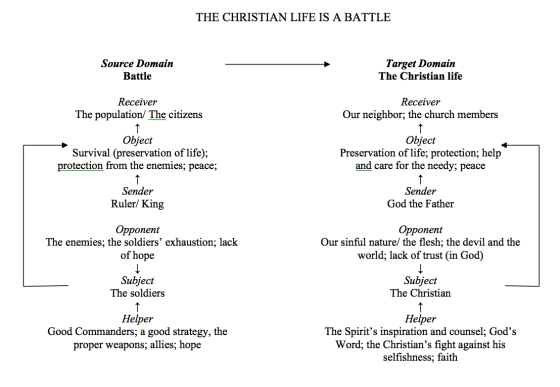
The Christian Life is a Battle

Figure 2 (Vertical Actantial Models in the Source and the Target[5])

In approaching the Christian life in terms of a battle, then, just as the Ruler or King wants to provide survival, protection and peace to the citizens through the soldiers, God wants to preserve life and to provide protection, help and care for the needy through the Christian.

And, while in the source the enemies, the soldiers’ exhaustion and their lack of hope oppose the soldiers, in the target our sinful nature, the devil, the world and the lack of trust oppose the Christian. Such oppositions intend to hinder the delivery of the Object to the Receiver. And that is way the function of the Helper is so important. Just as the commanders and good strategies help the soldiers to overcome the opponents and to deliver protection and peace to the citizens, the Holy Spirit and the Bible, for instance, help the Christian fight against his selfish sinful nature and, thus, care for his neighbors in their needs. The function of the Helper, therefore, is fundamental in the present metaphor.[6]  

o_cristo_redentorAnother fundamental point for the purpose of the present reflection is that the actant/ actor who does something for the Receiver is the Subject. Although the Sender sends the Object to the Receiver, the Subject is actually the one who does what has to be done in order to deliver the Object to the Receiver.

Therefore, the structure of the narrative relationships leads to the conclusion that protection and care for the needy, for instance, is something which comes from God and, still, that the Christian is the one who protects and helps the needy – the believer is the one who performs these works. When his or her selfish and sinful nature drives him to care only for himself, or when, in fighting against sin, he gets exhausted or even fails, he can resort and cling to the Helper.

Having in mind this clear understanding of the metaphor, Brazilian pastors could speak of and teach the Christian life in such a way that the good works performed by Christians are clearly understood as made not towards God – for God is not the Receiver – but towards their neighbors. This reinforces the distinction between justification and sanctification.  As Gustaf Wingren has puts it, God does not need your works, but your neighbor does.[7]

At the same time, in pastoral situations such as the ones elucidated by the hypothetical plea for help from a parishioner (described in Part 1), pastors can, in a very proclamatory way, affirm the presence of the Holy Spirit and point to Him as the one who will help and lead the parishioner during his or her times of struggles in life – The Holy Spirit will never abandon you! – They could say to their parishioners. Therefore, THE CHRISTIAN LIFE IS A BATTLE metaphor is able to render the Gospel and foster proclamation.

Avoiding Theological Confusion in Interpreting the Metaphor  

In the present paper,  the importance of who is doing what for whom and how in the narrative relationships of a given metaphor resides in the fact that in the salvation narratives central to Lutherans, for instance, God (probably in the person of Jesus) will always be the active Subject while we will always be the passive Receivers. In the Christian life narratives, on the other hand, the Christian might be the active Subject, which does not compromise the biblical salvation narratives. As Rossow has already pointed out,

Though Christians may be told to “fight the good fight” (1 Tim 6:12) or to “run in such a way as to get the prize” (1 Cor 9:24), the narrative structure of these metaphors for Christian living, with believers in the Subject position, will not set aside the passive nature of salvation highlighted in the more central metaphorical blend of courtroom/sacrifice, where believers are clearly placed in the Receiver slot.[8]

Earlier, we assumed that confusions between narratives (salvation and the Christian life) might create also theological confusion. This is one of the reasons for such an assumption: If one situates God (any of the three Persons) as the Subject in THE CHRISTIAN LIFE IS BATTLE metaphor, then he or she will have to place the Christian as the Helper. The Christian would then help God do his works. Such an idea – that God needs our help to accomplish his works, can lead to theological confusion, and might be not so comforting for a believer in his or her daily struggles against sin and difficulties in life, when his weakness is made evident, along with his necessity for someone who is stronger than him to help, and not the other way round.    

And, if the Christian is placed in the role of the Receiver in a warfare metaphor (such as the one we are working with here), then the narrative has been changed from the Christian life narrative to a salvation narrative, in which Christ fights on the cross and wins the battle for us – in this case we are indeed the Receivers. This victory is independent of our struggles – it does not depend on us at all.

In explaining the warfare metaphors in Paul, Williams makes a clear distinction between these two narratives:

The decisive battle was “out there” on the cross. But “in here,” in terms of our thoughts and words and deeds, the battle still rages. The flesh will not “lay down its arms” and is fighting a stubborn rearguard action. Thus, we must strive, under the command of God’s Spirit, to overcome the flesh by refusing to carry out its desires.[9]

The non-distinction between these two narratives (and their narrative relationships) has apparently caused a theological problem in some Neo-Pentecostal churches in Brazil. On the basis of Theology of Glory, leaders and members of Brazilian Neo-Pentecostal churches believe that the Christian life is a life of victory only, in which there is no room for defeat.[10] Perhaps a more comprehensive study of Theology of Glory could provide a more detailed description of the given problem, but for the purpose of the present paper it should suffice to say that the complete victory as a result of Jesus’ work – an eschatological victory, is being understood by Neo-Pentecostals as something to be enjoyed here and now, which configures the so called over-realized eschatology.

Another way of putting this would be to say that the final and complete victory as a result of Jesus’ work – salvation narrative – is being located in the present only, and being applied to the Christian life in the sense that instead of facing daily struggles in life, a true believer (supposedly) experiences daily victories.

How could, then, the present reflection help respond to such a view of the Christian life? Before attempting to give an appropriate response to the problem at issue, it would be important to look at David Maxwell’s study The Resurrection of Christ: Its Importance in the History of the Church. The study is about the Old Testament narratives that have served as the frameworks for understanding Jesus’ death and resurrection. It was was presented at the 17th Annual Theological Symposium, September 19-20, 2006, “Recapturing a Full-Bodied Theology of the Resurrection: Christ’s and Ours.” Maxwell’s conclusion paragraphs in his study helps us to trace the most relevant aspects of the paper for the purpose of our investigation:

The Day of Atonement narrative sees the cross as satisfying God’s wrath over sin. The problem with the Day of Atonement narrative is that it has no obvious place for the resurrection. The Passover narrative understands the cross as a victory of death because the blood drives the Angel of Death away. The resurrection is also seen as a victory over death because through it God leads His people out of bondage to Egypt and crosses them over to the Promised Land. […] In the stomping narrative the cross is seen as a temporary victory for Satan, but resurrection reverses this victory, crushing the serpent’s head. This narrative works well for dealing with the experience of defeat in the Christian life.[11]

By approaching these three narratives and showing how some Church Fathers and Luther worked with them Maxwell addresses the “zero-sum mentality that says if the cross saves us, then nothing else can.”[12] Maxwell’s study comes to meet our reflection because of what he calls the “stomping narrative”, which, in his own words, “works well for dealing with the experience of defeat in the Christian life” (as quoted above).

Maxwell identifies this narrative in Luther’s sermon on Mark 16 in which the reformer says that the resurrection saves (and not only the cross). In order to come to such a conclusion Luther refers to Genesis 3:15, where God affirms that “he [the offspring of the woman] will crush your head and you [the serpent] will strike his heel.” On the basis of this text, and viewing sin as an “enemy power,” the cross is described as a defeat and the resurrection as the victory; Satan and sin seem to win but, at the end, they are defeated by Jesus’ resurrection.

This salvation narrative allows us to see Jesus experiencing defeat before the final victory, the resurrection, and thus, leads us to expect the complete victory only in our resurrection. While we are in this world, however, we will experience both victories and defeats in our daily lives. Independently of whether a Christian has more defeats than victories in life, the final and complete victory has been guaranteed to us by Jesus’ resurrection.

In this sense, Paul says that God “gives us the victory through our Lord Jesus Christ” (1 Cor 15: 57). This text is within a resurrection setting in which it is made clear by Paul that such a victory will come to a completion only at the end, in Jesus’ second coming, “at the last trumpet” (15:52) on the day of the resurrection.

Therefore, in expecting only victories in their lives, Neo-Pentecostals are mistakenly locating the complete victory achieved by Jesus’ resurrection here and now, while Paul locates this victory at the last day – at the resurrection. At the same time, both Paul’s understanding of the Christian life as well as the Brazilian culture drive us to reaffirm that the Christian life can be helpfully seen as a battle, in which there are daily victories and defeats and also the eager expectation for the final and complete victory, just as a soldier expects for the day when the war comes to an end.

Testing the Limits of the Metaphor

            “Metaphors both reveal and conceal important aspects of any Target Domain,”[13] says Rossow, as he suggests that, in working with metaphors, pastors might find necessary to test the limits of a given metaphor so that misinterpretations may be avoided and important things may be added to what is being taught and proclaimed – this is one of the four metaphor moves for preaching.

THE CHRISTIAN LIFE IS A BATTLE metaphor might be useful for both the catechetical and homiletic tasks and also for pastoral counseling in Brazil. And, in any of these three pastoral tasks the given metaphor move may help the pastor use the metaphor more effectively. This is due to the fact that the culture the parishioners/ hearers are in might drive them to draw wrong inferences from the metaphor. These are some possible misunderstandings which Brazilian pastors should be aware of:

  • Since we are living in a very individualistic culture, parishioners/ hearers might think that they have to fight for themselves and not for others. This idea is opposed by what the Actantial Model (See Figure 2) shows – that a soldier fights for the best of the citizens, and so the Christian fights for the best of his neighbors, and not for himself only.
  • Since the Bible talks about demons possessing people and Jesus casting the demons out as well as about the devil as an enemy, some people might think that the world is a battle field in which there is a fight between good and evil, and that we have to help God (the good one) fight against the devil (the evil one).
  • Since the world is portrayed also as an enemy in the Bible and, therefore, occupies the position of opponent in the narrative relationships, the parishioner might forget that the world is, at the same time, the focus of the mission of the Church, “For God so loved the World […]”, and Jesus told the disciples “to make disciples of all nations”. Therefore, in using the suggested metaphor in a sermon or in catechesis it would be very important to explain these aspects of the term world.

In sum, in order to avoid these wrong inferences, Testing the Limits of the Metaphor provides a way for pastors to talk about those kinds of things concealed by the present metaphor. Such things might be other important aspects of the Christian life, or even some aspects of Jesus’ work on the cross for our salvation (the objective fight), referring then to a salvation narrative without confusing them.

This way, pastors can, in testing the limits, remind their parishioners/ hearers that, although the war is not over yet, our enemies have already been defeated and that when Jesus comes again the war will come to an end; then, the Christian’s enemies will be finally destroyed. Also, pastors can emphasize that our struggle continues not because God needs our help, but because our selfish nature needs to be fought so that our neighbors may be protected and helped in their needs. 

Conclusion
the_boxer_4LIFE IS A BATTLE is a conceptual metaphor in the Brazilian culture. By such a metaphorical concept, and taking into consideration Saint Paul’s way of speaking of the Christian life, we have seen that THE CHRISTIAN LIFE IS A BATTLE is a metaphor which might render the biblical teaching of the Christian life and foster the Christian proclamation to Brazilians.

Also, it was seen that the use of actantial models for both the source domain and the target domain placed next to each other allows us to see the correspondences of the two domains; we can see how they are related. Along with this, the narrative relationships of the metaphor at stake, clearly visualized by the actantial models, might help Brazilian pastors/preachers work with the present metaphor, making the proper distinction between the Christian life narrative and salvation narratives.  If in salvation narratives God is always the active Subject, in the (implied) narrative of THE CHRISTIAN LIFE IS A BATTLE metaphor, the Christian will be the active Subject.

At the same time, as seen above, this metaphor provides a way to talk about the Christian’s fight against sin and about the good works performed by them as being made towards their neighbor, not towards God. This reinforces the distinction between narratives or, to put it in systematic terms, between justification and sanctification.

Finally, THE CHRISTIAN LIFE IS A BATTLE metaphor, along with the “stomping narrative” of Luther, can help us address the problem of an over-realized eschatology in which Brazilian Neo-Pentecostal Christians understand the Christian life as a life of victory only. Seeing the cross as a defeat and the resurrection as Jesus’ victory against Satan, as Luther did, along with Paul’s understanding of our resurrection, leads us to locate the Christian’s final and complete victory at our resurrection, on the last day.

To speak, therefore, of a complete victory is something that belongs to a salvation narrative in which Christ has already fought, alone. In the Christian life narrative approached in this paper, however, the Christian is seen as soldier who will continue fighting until the war is over. But the Christian is not alone, for just as a good commander never abandons his soldiers, the Holy Spirit will never abandon the Christian.


Notes

[1] David J. Williams, Paul’s Metaphors, Peabody: Hendrickson Publishers (1999), 213.

[2] Leland Ryken, James C. Wilhoit, Tremper Longman III, Dictionary of Biblical Imagery, Downers Grove: Inter Varsity Press, (1998), 211-213 – Divine Warrior.

[3] The idea of working with the given metaphor in this paper is not to use a specific Bible passage but the general biblical understanding of the Christian life in terms of warfare. When using one specific passage in which the warfare metaphor is played, then the pastor could work with the expressions and development of the given text. In Romans 7, for instance, “waging war” and “making me captive” would play a very important role in the development of the sermon.

[4] Rossow, Preaching the Story Behind the Image: A Narrative Approach to Metaphor for Preaching, 54. Rossow suggests this way of placing the two actantial models next to each other so that it may be more clearly seen “how the two domains relate to each other.”

[5] Rossow, Preaching the Story Behind the Image, 55. In presenting the actantial models this way, Rossow provides a clear visualization of how “relationships and outcomes assumed by the source are intended to correspond to relationships and outcomes in the target: Helpers align with Helpers, Opponents with Opponents, and so on.”

[6] This explanation of the narrative relationships is not, of course, what pastors/ preachers will explain in a sermon, if they use the present metaphor. In preaching, the source domain, for instance, should be evoked in such a way that the preacher not only tell things but show those kinds of things in the source which will help the hearers make the proper inferences in the target. Since in the present metaphor the Helper has a fundamental role, in evoking the source the preacher could, for example, emphasize the soldiers’ exhaustion and lack of hope in a battle along with the importance of having a good commander, who never abandons his soldiers. This will lead to the inference that the Holy Spirit will never abandon the Christian in his daily struggles.

Since the goal of the present paper is not primarily to work with the suggested metaphor in a sermon, but to show how the conceptual metaphor LIFE IS A BATTLE might be helpful for speaking of the Christian life to the Brazilian culture, we are not going to provide examples of how this metaphor should be played in a sermon.

Still, we consider Rossow’s suggestion as fundamental for the homiletic task, as one works with metaphors in preaching. The four metaphor moves suggested by Rossow may serve for structuring the progression of a sermon and for its development, as rhetorical units. https://justinrossow.com/the-basics/preaching-metaphors-we-live-by/ (accessed February 10, 2013).

[7] Gustaf Wingren, A Vocação Segundo Lutero, Canoas: Ulbra, Porto Alegre: Concórdia, (2006), 21.

[8] Rossow, Preaching the Story Behind the Image, 210, 211.

[9] Williams, Paul’s Metaphors, 214.

[10] Ricardo, Mariano. “Neopentecostalismo: O Novo Modo de ser Pentecostal,” in: Márcio Fabri dos Anjos, Sob o Fogo do Espírito. São Paulo: Ed. Paulinas, 1998, 19-37.

[11] Maxwell, David. “The Resurrection of Christ: Its Importance in the History of the Church.” Concordia Journal 34 (January–April 2008), 35.

[12] Ibid., 31.

[13] Justin Rossow, “Preaching Metaphor.”   (accessed on February 09, 2013).

Leave a comment

Relationship Triad: Session 4

Dietrich Bonhoeffer’s Life Together

One Anothering, vol. 1 by Richard C. Meyer

Session 4


Before You Meet

I. Meditate 3-5 times on James 1:12-26  this week.

  1. OneAnothering CoverStart with prayer for yourself and for others reading the same verse, that the same Spirit that inspired these words would open your heart and mind to them as well.

  2. Then read (often out loud) and reread, stopping to ponder particular phrases or words. Go back to the same 10-15 verses multiple times in the same week.
  3. Taking notes on what the Word is doing in you is often helpful. If stuck, you can think through questions of the text like does this challenge me? Convict me? Does it promise me anything? How does it point to Jesus?
  4. After chewing on the Word, close with prayer, often turning the same verses you are reading into a prayer back to God.


II. Read Life Together, CH 4 (Ministry).
Highlight and/or take notes for discussion.

III. Read  Meyer’s One Anothering, vol. 1, Chapter 4, “Care for One Another.”
Try to identify “care” and “cure” statements during your week and write them down to share.

IV. Watch the sermon “Not Alone,” below.
Write down some observations/reflections.


The Day You Meet

  1. Interact with the material: based on your written notes, what was new; what did you question; how will you apply it?  etc. Did you see any of this going in in your week?
  2. Finding Connections to Real Life: Share the “care” and “cure” statements you identified in your week. How did/could things go differently?

  3. Prayer: Like Session 1, end with a “popcorn prayer.”  One person begins, “Father of all, we lay before You these joys and concerns . . .” and then pauses. In any order, as thoughts come, anyone can add a brief petition, ending with the words, “Lord, in Your mercy, . . .” to which all reply:  “Hear our prayer.”

    This continues as the Spirit leads (it often starts out slow, builds, and then slows to nothing, kind of like popcorn popping . . .) until everyone seems to have prayed everything they are going to for now. Then the same person who began the prayer ends, “We pray this all in the name of Jesus, Amen.”


[What’s a “triad?”]

[Intentional Relationships Triad]