3 Comments

6 Tips for Preaching a New Structure

I forgot how uncomfortable it can be to test-drive a sermon structure you’ve never used before. Before you buckle up and take a new design out for a spin, here are some tips to get you–and your hearers–home safely.

1. Keep Your Goal in Mind

I find the best way to use sermon structures effectively is to have a clear sense of what you are trying to shape in the hearts and lives of your hearers before you ask which structure helps you get that done. In other words, figure out what you are trying to say before you figure out how you are going to say it.

So the structure isn’t the most important thing about a sermon; the structure helps you do the most important thing: bring God’s Word to God’s people in a moment of grace.

When you go to try a new structure, make an intentional choice. Pick one that seems to help you accomplish the goal you have in mind. Of course, since the structure is new to you, you aren’t exactly sure how it’s going to play out. But not knowing all the details won’t stop you from making that choice intentionally.

Once you know the goal you have for the faith and lives of your hearers, keep that destination clearly in mind as you experiment with a new structure. Be willing to change structures if the one you chose just isn’t working. The first time I tried to preach a Relational Structure, it ended up being a Multiple Story Structure. That’s OK. It just means it might take you more than one try to get the hang of something new.

Keep the goal of your sermon in mind, and make sure the structure serves the goal.

2. Pay Attention to Your Transitions

If I have trouble remembering what comes next in the sermon, it’s probably a structure problem. If the transitions don’t keep the flow moving naturally, the structure itself will be less effective for the preacher and hearers.

In fact, you can identify many sermon structures simply by the transitions. As you move from Oops! to Ugh! in a Lowry Loop, or from the first inadequate answer to the second, better-but-still-inadequate answer in a Question Answered design, or from one side of a seemingly contradictory truth to the other in a Paradox Maintained sermon, the transitions all sound and feel identifiably unique.

[Side note: I like to play a Sunday afternoon game with my 9th-grade daughter where she has to guess the sermon structure from worship–and tell me her reasoning (Best. Dad. Ever.). A few weeks ago I started the sermon by saying, “I’d like to share three stories with you today …” She had the Multiple Story Structure nailed before I got through my first sentence.]

All that is to say, transitions are the most unique and identifiable part of any sermon structure. So if you are preaching a structure that is new to you, spend some extra time paying careful attention to how one section of the sermon flows naturally into the next.

Transitions are a roadmap for your hearers; if you are less familiar with the terrain, make sure the map makes sense to you before you try and take your hearers on a tour of the surrounding countryside.

3. Give Yourself Extra Time

You’ve got four weddings and a funeral scheduled, and the voters meeting got moved on top of the confirmation parent meeting, and that’s when you have three unexpected crisis counseling sessions. We’ve all had those kind of weeks.

At the risk of being obvious, that’s not a week to try out a new structure. When time is tight, you want a comfortable sermon flow you know inside and out. Chances are, you’ll be lucky to have a complete outline by Sunday morning, so you need to know it well.

Plan an extra 20-25% for prep time if you are using a less familiar structure. You’re going to have to do more rewriting and even some rethinking. Your patterns of preparation are refined through well-worn usage to get the product you are currently producing. Try something new and the old process just doesn’t work the same.

And that’s OK. In fact, it’s exciting. Who wants to preach (or listen to!) the same sermon week after week? Just plan ahead, cut out an extra meeting or two, pencil a rewrite into your calendar, cancel a staff meeting–intentionally plan margin. With a new structure, you just might need it.

4. Trust the Process

Have you ever taught a kid how to ride a bike? It seems completely ridiculous that moving forward would keep you from falling over. Your first reaction when that bike starts to wobble is to back off, protect yourself, slow down; and that’s when you bite the dust.

Preaching a new sermon structure is like that.

You’re trying to make the thing work. You get a little forward momentum, and all of a sudden it feels like you are going to crash and burn. It doesn’t hold together the way you thought it would. The transitions don’t feel natural. It’s like you got up on the bike for a second, you saw the 3D treasure chest at the bottom of the magic picture, and then, all of a sudden, you lose perspective and come to a grinding halt.

Your first reaction will be to scrap this silly new structure and revert to your go-to sermon outline just to get it done by Sunday. (That’s one reason you need more time, time to start to succeed, and then to fail, and then to work through it.)

Sometimes, you really should scrap this draft and start over with a different structure. And sometimes you need to trust the process and shape the sermon in ways that others have found helpful, even if you don’t quite see it yet.

If the goal of your sermon fits the new structure, don’t give up too easily. Trust the process. Don’t evaluate the structure based on what you imagine will go wrong; try it out and evaluate what actually happens.

5. Don’t Judge By Feel

When I preached that new sermon structure a few weeks ago, I realized something that is often hidden from my conscious experience: I evaluate a sermon while it is happening.

How are people responding? What non-verbals are they sending? Did they get quiet and focused at the right spot? Did they laugh when that tension was released? Did they experience the Gospel where I thought they would?

All of these and many more minute data points are observed and processed in the act of preaching. The preacher uses that feedback loop to pick up pace, dwell longer on a topic, make a clarifying statement, or rephrase on the fly.

But that feedback loop is tuned to the sermon structure. When you are familiar with a structure, you know the contours of the whole, what to expect when, and how you can make natural adjustments based on the input you are receiving from your hearers.

I found that my feedback loop was disrupted when I preached a new structure. I felt slightly disoriented as I engaged the people and evaluated their response. I didn’t have a set of expectations on which to evaluate the sermon. I wasn’t sure how it was going, or even how it went.

I imagine most preachers have a sense about whether they preached the sermon they intended or not. Of course, we trust the Holy Spirit to work in the Word whether we have a good day in the pulpit or not. And since the hearers bring almost as much to the sermon as the preacher does, we can’t take too much credit (or blame) for what gets heard and lived out.

But still, there are times when you leave the pulpit with a prayer of thanks, and other times when you leave praying for divine intervention; some sermons “work” while some “fall flat.”

When I preached a new structure, I discovered I wasn’t able to evaluate the same way I usually do. If I trusted only my experience of the sermon, I might never use that structure again. But I sought input from trusted listeners and was able to evaluate based on their input as well as my own.

When preaching a new structure, don’t jump to conclusion based on your experience of the sermon. Your sense of the sermon will be less accurate precisely because the structure is new.

6. Get Right Back in the Saddle

The first time I tried to preach a Relational Structure, I ended up defaulting to a more familiar structure because it just wasn’t working. It took me almost a year to try again.

I used that Relational Structure four weeks ago in a sermon, and it went–well, it was hard to evaluate exactly how it went. But outside input leads me to believe it went just fine.

This weekend I am preaching, you guessed it, a Relational Structure sermon again. I didn’t force it, but the goal of the sermon and the topic at hand seemed to make it a natural possibility. So I opted to preach that new structure again soon after I gave it a shot for the first time.

You probably aren’t surprised that the  process went a lot smoother this time around. I had a much clearer idea of what should go where, and how to make the transitions seem natural and obvious. The structure shaped what I wanted to say in ways that helped me say it and, I think, will help the hearers experience it.

The second time around is way more natural than the first.

Obvious, right? Just remember that obvious truth the next time you use a structure that’s new to you. The first couple attempts might be a bit bumpy, or even painful. Pick yourself up, dust yourself off, and get right back in the saddle.

Your hearers will be grateful you did. And so will you.


Looking for a new sermon structure to try? Consider experimenting with Frame and Refrain, Question Answered, or Metaphorical Movement structures. These and many more are described succinctly at https://concordiatheology.org/sermon-structs/

You can find other blogs related to sermon structures on this site by going to the tag Sermon Structure.

4 Comments

Test-Driving a New Sermon Structure

Trying something new for the first time is always a little uncomfortable.

Sermon structures are no different. The first time you test-drive a shiny new sermon structure, it’s easy to feel like you are slightly out of control. Your natural cadence, your expectations, your anticipation of what your hearers will do next, your flow–all of that gets thrown out the window and it’s easy to feel a little disoriented in the pulpit.

I know that. I’ve lived it. I’ve taught it. But I kind of forgot it.

I recently preached a sermon structure I had never used before. I chose a Relational Structure because it seemed to fit so well with what I was trying to accomplish that day in the hearts and lives of my hearers. I thought it fit the theme and the content of the sermon well. And I thought it would be good to try a structure that was new to me. After all, there are maybe a dozen or so different ways of organizing a sermon that I use fairly regularly, so I thought it would be *fun* to try something new.

That’s when I remembered: trying something for the first time is always a little uncomfortable. From the writing process to the delivery, this sermon was all uphill.

What I found most disconcerting was the actual experience of preaching. I discovered again that every preacher has a rhythm, an expectation, a give and take with the hearers. One reason you change sermon structures from week to week is so that the rhythm doesn’t become a rut. As soon as your hearers can time their pot roast by your sermon, or reach for their offering when you get to that standard phrase on page four, you’ve lost an important element of preaching.

So using a variety of forms is a service to your hearers. But using a new form is a special challenge for the preacher. Because the people don’t laugh where you expect them to. They become thoughtful at unusual times. Your internal clock that measures the time of the sermon and the Law/Gospel experience of the hearers feels like it has lost calibration.

It’s uncomfortable trying something for the first time. After worship I found I wasn’t even sure how the sermon had been received. I usually know when it feels like the sermon connected and when it feels like I didn’t quite get the message across. Thank God, sanctified ears still receive God’s Word even when I am not on my game. But this wasn’t a “bad” sermon; at least, I don’t think it was. And it didn’t feel like a “good” sermon, either. It just felt, well, different than I expected.

Which is really just what I should have expected. So next time you challenge yourself to try a new sermon structure in order to more faithfully proclaim God’s Word and more humbly serve your hearers, remember it ain’t easy. Expect it to feel different than you expected. And check out these six tips to help you screw up the courage to test-drive a different sermon structure.

Trying something new for the first time can be a little uncomfortable. But the payoff is huge. You and your hearers will both get more out your preaching ministry if you continue to add tools to your bag, one slightly uncomfortable sermon at a time.

2 Comments

That One Time I Accidentally Said, “Kiss My A**” Three Times During the Gospel Lesson

I plead ignorance on this one.

But the situation still brings up legitimate questions of communication, cultural norms, and offense as a preaching technique that Jesus seemed to use, but maybe we shouldn’t …

OK; here’s the situation. I’m preaching on Luke 14, the Parable of the Banquet where the rich guests who were invited (and RSVP’d, by the way) all give the lamest of excuses for not showing up after the caterers have already put the food on the serving table.

As a lead in to the sermon, I am reading the Gospel Lesson, Luke 14:1-24. Now, friends, 24 verses is a lot of reading to do straight up from the pulpit, so fearing an onset of sudden narcolepsy, I chose to present the lesson as much as read it. Those verses include several different conversations and interactions and at least two different parables, so using the space of the sanctuary seemed like a good way of breaking up the reading and making it more understandable for the hearers.

And that was the goal, making it more understandable for the hearers. So I played the opening scene with the man with dropsy to one side of the congregation. The table with the Pharisees I imagined on the other side. The conversation with the host of the banquet was demonstrably an aside. A teacher of the law piped up from back at the table, and Jesus answers with a parable. So far, so good…

Here’s where I ran in to trouble.

I wanted the hearers to get a handle on just how offensive the guests were when they reneged on their RSVP. I mean, “I just bought a field and now I have to go see it???!!!” How lame can you get? I have to go watch the paint dry, I have to go trim my nose hairs, I have to go feed my fish, Mr. President, so I can’t make it to the ballroom for the dinner now that the food is being served!

It’s not only rude, it is a conscious rejection of the relationship and equal social status implied by accepting the invitation in the first place. These guys aren’t just too busy, they are intentionally trying to ostracize the host!

So I wanted to get some sense of that across to the congregation as I read the Gospel Lesson. So after each, “Please excuse me,” I added a hand gesture.

Mind you, it was not the first hand gesture I thought of in this context. Nor was it the second, I might add. Overall, I thought my filter was working quite well.

So I was mildly surprised when my own Mother graciously asked me afterward, “Justin, what does sticking your thumb on your nose and wiggling your fingers mean to you?!”

I told her I thought it was roughly equivalent to sticking both thumbs on your temples and waving moose antlers at someone, kind of like saying Na-na Na-na Boo-boo, or sticking out your tongue. That’s when dear old Mom dropped this one on me: “I always thought it meant, Kiss my a**.”

Oops.

Thanks, Mom.

Now, to her credit, my Dad thought the same thing. I did a non-scientific poll over the next couple of days, and it came back about 50/50: half the people thought the gesture meant a more general disrespect for authority, the other half thought it was a specific invitation for lips to meet glutes.

In my own defense, I’ve done as much Google searching as I can stand on the subject, and I cannot find the more narrow meaning listed, though “thumbing your nose” does have some interesting variations and etymology.

But it doesn’t really matter if I can find it in a dictionary; meaning is in the eye of the interpreter. Some of the people in a worship service at my church are sure they saw their pastor use a hand gesture that meant something specific and vulgar while reading the Gospel lesson!

So the real question is, is it ever OK to give offense as a communication device?

Is it ever OK to give offense as a communication device?

When I considered presenting the Gospel lesson in a somewhat dramatic format, I risked offending some people. I know our crowd, and that was not a concern for me.

When I chose even a mildly disrespectful hand gesture to accent the meaning of the text, I risked offending some people. In this case, the risk seemed small to me and defensible based on what I wanted to do in the sermon.

Had I thought my people would think the gesture was more vulgar and rude than I intended, I would have chosen differently.

But why?

Because giving that kind of offense in this context would have gotten in the way of hearing the message.

At least I think it would have. But the people hearing Jesus speak would have certainly been offended–if not scandalized!–by some of what He said and how he said it. There are times Jesus seems to go out if His way to say something offensive or shocking to wake people up, or tear down their defenses. In those cases, Jesus met hardness of heart and closed ears with a kind of holy offense designed to unclog the hearts and minds of His hearers.

Is it ever OK to do that today? Would you intentionally give offense from the pulpit to make a point?

For me, the preaching ministry of the Church hinges on mutual love between the one preaching and those seeking to hear Jesus in the sermon.

Loving your hearers means not giving unnecessary offense, not putting any stumbling block in front of those who need to hear a Word from the Lord.

Loving your preacher, on the other hand, means listening for Jesus not only because of, but sometimes in spite of, what’s coming out of the preacher’s mouth; putting the best construction on everything; being slow to take offense and quick to understand the best possible intention.

Having a relationship of trust, love, and respect between hearers and speakers in the preaching ministry of your congregation means the preacher will be willing to take risks and the hearers will be willing to overlook failure. Love covers over a multitude of homiletical sins.

Preaching the Word on a Sunday morning is a joint effort of the hearers and the speaker, and Jesus’ Spirit is active in and through both. I don’t think intentional offense fits in that model, though risking offense in order to present God’s Word it almost necessary.

So if you are a member of my family of faith and I offended you with my delivery of the Gospel lesson, I trust you have already given me the benefit of the doubt and forgiven me for whatever offense I gave.

And if you thought the reading of the Gospel lesson was awesome and helped you understand the text better, great! That’s what I intended.

And if you weren’t offended this time around, give it time; I am willing to take risks in the pulpit because I trust your sanctified ears and hearts. Which means I will also occasionally make the wrong decision, or cross the wrong line, or simply mess up.

Please love me and forgive me and know that my heart and soul go into helping you know and follow Jesus, and I could never get in the pulpit in the first place if we didn’t already have that in common.

And if you missed it, you can see the Gospel lesson, and the sermon, below. Just listen with baptized ears…

Leave a comment

You ARE His Witnesses

I had a chance to sit down with a preacher after I listened to his sermon. I find the conversation about preaching can be fascinating, and really helpful for those who face the art, craft, and challenge of preaching on a regular basis.

The text for the sermon came from the assigned readings for Ascension, which we celebrated on a Sunday. With all of the stuff going on in those texts, you have to narrow the scope from what you could say, to what you are going to say. Hearing the thinking behind this sermon preparation process helps preachers refine their own process; and it helps hearers better understand what goes into what they hear on Sunday morning.

In the following interview, Pastor Matt Hein and I talk about how he chose the text to preach on and how he decided to shape the sermon the way he did. You will hear us talk about the structure of the sermon (the way the sermon experience is shaped over time) as well as different moments of reflection within the sermon.

The structure for this particular sermon is called Frame and Refrain, which you can read more about here. This kind of sermon begins with a story or image that helps shape a central thought for the hearers and leads to a clear expression of the theme. That theme is repeated as a refrain several times during the sermon, and the original story or image is repeated at the end of the sermon, and therefore frames the entire presentation.

Although the interview talks a lot about the structure of the sermon and how it worked, you will also hear other important preaching themes: how do you use a personal story from another person’s experience? How do you preach sanctification? How do you approach the text as a hearer first, and secondly as a preacher? These conversations flow naturally from the discussion of the preacher’s experience of the preaching event.

Check out the video and then watch the sermon, below.


Now that you have heard what the preacher had in mind during the preparation of the sermon, listen for those dynamics in the sermon below. As you listen, also pay attention the the way metaphor gets used not to structure the progression of the sermon but as part of the development. You can hear the basic metaphor moves of Evoking the Source, Mapping to the Target, Testing the Limits, and Seeing with a New Lens, especially in the discussion of witnesses and what makes them credible.

Every sermon brings a wide range of dynamics to bear on the preacher, the hearer, and the community. How do you experience sermons on a regular basis? How does learning more about the sermon writing process help you be a better hearer? I find the more I process a sermon with a few other people, either as a preacher or as a hearer, the better I am able to identify what Jesus is speaking into my life and what kind of response He is shaping in me.


Leave a comment

The Dead Sea and the River of Life

by Justin Rossow

The following sermon is based on the vision recorded in Ezekiel 47:1-12. Revelation 22:1-7a and John 4 were also used in worship that day.

We often think of metaphor as using something we know to help us understand something we don’t know. While that may often be the case, it’s hardly a fast rule and has very little to do with identifying what a metaphor is or how it works.

Metaphor is talking about, experiencing, or reasoning through one thing in terms of something else. As far as metaphor is concerned, we can borrow inferences and logic from an unknown and apply it to a known just as easily as the other way around.

In the case of this sermon, I am using something my hearers don’t know a lot about—a vision from Ezekiel and geographic data about the Dead Sea—and using it to shape how they experience something they know well—their own sin and the forgiveness we have in Jesus Christ.

The sermon itself is structured as a Four Page sermon, moving from (1) the Trouble in the Text to (2) the Trouble in the World, followed by (3) Grace in the Text and (4) Grace in the World. In this kind of sermon structure, the experience of Law and Gospel are divided fairly equally in the major sections of the sermon (unlike other structures, where Law and Gospel may be experienced from within each of the moves of the sermon).

In this case, Ezekiel’s vision of the river of life flowing from the Temple of God and transforming the Dead Sea is used as the central image of the text. And, even though the sermon progresses in the Four Pages structure, you can still identify the metaphor dynamics of Evoking the Source, Mapping to the Target, and Seeing through a New Lens.

Here, then, is the sermon.

Sermon Introduction: Evoke the Source

2,600 feet above sea level: that’s how high you would be if, at the time of Ezekiel, you were standing at the top of the broad staircase that led up to the Temple of God in Jerusalem.

From this height, you can go down, down the steps of the Temple, down Temple Mount, down through the city of Jerusalem, down the Kidron Valley, down through the hill Country of Judea, down through the desert region of the Arabah, down into the Jordan River Valley, down, down, down, down, down …

From 2,600 feet above the Mediterranean Sea at the Temple, to 1400 feet below sea level, you have gone down 4,000 feet. You have traveled about twenty miles East and South and three quarters of a mile straight down, to the lowest land elevation on the planet.

And there in the depths, at the lowest point on earth, you find a lake of salt we know as the Dead Sea. The Dead Sea is over eight times saltier than the ocean, so full of salt that there are no fish. There are no frogs. There are no snakes. So full of salt, that there is no grass. There is no seaweed. There is no life.

The Dead Sea lives up to its name.

If you or anyone you know has ever been, you probably know it’s easy to float in the Dead Sea. The water is almost 1/3 salt, so even a bowling ball will float! (And by that I don’t mean a person shaped like a bowling ball; I man an actual bowling ball!)

It sounds fun, but if you go, keep your head above water. They say the salt fiercely burns your eyes, and the taste is not just salty, it’s terribly bitter!

The thing I find most startling about the Dead Sea is this: no matter how much fresh water flows into it from the Jordan River or one of its tributaries—no matter how much fresh water pours in, the Dead Sea remains DEAD.

Trouble in the Text: Map to the Target (1)

In our text for today, Ezekiel sees a vision of the Dead Sea. Ezekiel and his people knew about the Dead Sea. They had experience with the Dead Sea. Maybe they even floated in the Dead Sea! And they knew first hand how dead their own spiritual lives could be.

You see, Ezekiel is a priest who should have ministered in the Temple of God in Jerusalem, except that he was with the first wave of Israelites taken into exile in Babylon. Because these people had persistently and relentlessly turned away from the loving embrace of their God, finally, finally, finally, God’s judgment spilled over and washed them away.

Destruction. Captivity. Death. Ezekiel speaks God’s Word to God’s people stuck in the lowest point of their history as a nation. And his word of judgment on the people and their trust in external religiosity is harsh indeed.

According to God’s Word spoken through the prophet Ezekiel, this first wave of exile would not be the last. The city of Jerusalem would be utterly destroyed. And the Temple of God, the sign of the presence of the Living One in the midst of His people, even the Temple itself would be toppled to the ground.

Like Ezekiel’s vision of the valley filled with dry bones, like the view standing on the shore of a sea of salt brimming with poison, there is nothing on the horizon but death.

The righteous judgment of the Almighty burns their eyes and is bitter to the tongue. And nothing they do, no matter how hard they work or how many vows they take, no matter how much they try to change themselves, the Dead Sea remains dead.

Trouble in the World: See Through a New Lens (1)

Maybe you know something of what that feels like. Maybe you have experienced the bitter taste of a failed relationship, a relationship you swore would be different this time! And you worked so hard to be better and kinder and more loving. And you thought you did everything right. Yet the same old patterns of distrust and anger and lies cannot be so easily washed away.

And it’s bitter, O so bitter, when you pour yourself into a relationship and it’s not enough. No matter how much you try to change, you can feel the relationship beginning to wither, and even die.

Or maybe you know what it’s like when the salt of your own tears fiercely burns your eyes. When the diagnosis that seemed so promising has turned grey and hopeless. And after you have tried every medical solution, and explored homeopathic remedies, and prayed and prayed and prayed, and your church prayed, and all your Facebook friends prayed, but nothing you do can change the harsh reality of a terminal diagnosis. You once had hope, but now all you can see is destruction, captivity, death.

Or maybe you know what it’s like to turn your back on God. To make vow after vow to change your attitude or behavior only to break every one. Maybe you’ve gotten caught up in a religion of externals that trusts more in the worship service you perform than the God who wants to meet you there. Perhaps faith has again become stale and salty–turgid, brackish–and your faith feels like it’s about to die.

And no matter how hard you try, no matter how much you want to feel refreshed and renewed, no matter how many Bible study helps you use or spirituality books you buy, you just can’t escape the reality of your own sin. You used to think sin was just your bad habits, and now you suspect it’s your way of life.

And when you reach that low point, when you have gone down, down, down, away from God’s Temple, away from God’s presence, away from God’s promise, you find yourself looking at a horizon of hopelessness, a sea of death.

Grace in the Text: Map to the Target (2)

Ezekiel preached to a people who knew the burn of tears in their eyes and the bitter taste of judgment on their lips. Ezekiel’s vision was expressly given to people who were experiencing death—spiritual, physical, relational death—in their lives and in their bodies.

For the sake of these people who were experiencing death, God takes Ezekiel in the Spirit back home from exile, into a future where the Temple has already been restored, where judgment has already been reversed.

There, Ezekiel himself sees a vision of pure, fresh water, at first just a trickle, coming out from under the threshold of the Temple, from the very dwelling place of the LORD Most High.

As that trickle works it’s way down the Temple steps and through the streets of Jerusalem, the trickle begins to deepen. By the time Ezekiel leaves the city, it swirls around his ankles. By the time he crosses the Kidron Valley, it’s around his knees. As he walks through the Hill Country of Judea, it’s up to his waist.

Down, down, down, the grace of God flows, until by the time it reaches the banks of the Dead Sea, the water from the throne of God is a rushing torrent, a powerful flood that Ezekiel cannot hope to cross.

And unlike anything else in the history of the Dead Sea, this time, this time the fresh water wins! This time the flood of grace makes the change no human effort could effect! This time the living water from the presence of God transforms the lowest place on earth.

Where there was only salt, the fishermen now cast their nets; where there was only death, now trees on both sides of the river bear fruit for life and leaves for healing. Where there was only a valley of dry, dead bones, where poison and barren emptiness had dominated the landscape, now God Himself brings forth renewal, refreshment, life!

Grace in the World: See Through a New Lens (2)

Do you see? Do you understand? That’s not just a vision for ancient Israel. That’s you! That’s your story! That’s the depth of your sin and the barren landscape of your life! And no matter how hard you try, you can’t make yourself better, you can’t dilute the poison, you can’t bring life from the waters of death.

But Ezekiel has a vision to share with you today, even as your eyes burn from the salt of your tears, even with the bitter taste of judgment still on your lips.

Ezekiel looks up and sees water, life-giving water, trickling down from the very presence of the Almighty God.  Down it flows from the steps of the Temple, into the Temple court where Jesus is teaching: “The water I give them will become in them a spring of water welling up to eternal life.”

Down the water runs, down to the edge of the Kidron Valley, around the base of Skull Hill, where Jesus is raised by a cross in death. As the Savior is lanced with a Roman spear, blood and life-giving water flows.

Down, down, it courses,
through the Hill Country of Judea, where Jesus was born in a Bethlehem stall,
down through the desert region of the Arabah, where Jesus went toe to toe with the Tempter for you and won,
down into the Jordan River Valley, where Jesus joins the waters of your baptism to His own saving mission,
down, down, down the grace of God flows until it is a relentless river, an overwhelming current, a powerful flood.

And when the water of God’s grace and mercy in Jesus Christ gushes into the lowest part of your life and the deadest corner of your soul, an amazing thing happens: life.

Life! Full and abundant and teaming and free. What you could not by your own effort effect for yourself, the grace of God washes over you in a torrent of tender love.

Gone the judgment. Gone the pain. Gone the separation. Gone the death. A vision of a promise so powerful, that even though it will not bet finally and completely fulfilled until death is washed away forever, already now we experience the shock wave of this eternal transformation.

Already now, relationships begin to heal. Already now, tears are wiped from faces. Already now, sins are fully and freely washed away.

Conclusion:

By the waters of your baptism, the eternal river of life determines your reality already now far more than any sea of death ever could.

Already now, you have been buried with Christ by baptism into death and raised with Him to newness of life. Already now, you have received the sign of the cross on your forehead and on your heart to mark you as one redeemed by Christ, the crucified. Already now, you have been baptized in the name of the Father, and of the Son, and of the Holy Spirit.

So that just as much as the vision of the prophet Ezekiel is meant for your present, so also the vision of the apostle John defines YOUR future:

Then the angel showed me the river of the water of life, as clear as crystal, flowing from the throne of God and of the Lamb down the middle of the great street of the city. On each side of the river stood the tree of life, bearing twelve crops of fruit, yielding its fruit every month. And the leaves of the tree are for the healing of the nations.

No longer will there be any curse. The throne of God and of the Lamb will be in the city, and his servants will serve him. They will see his face, and his name will be on their foreheads. There will be no more night. They will not need the light of a lamp or the light of the sun, for the Lord God will give them light. And they will reign for ever and ever.

The angel said to me, “These words are trustworthy and true. The Lord, the God who inspires the prophets, sent his angel to show his servants the things that must soon take place.”

“Look, I am coming soon!”

Amen. Come, Lord Jesus.

Leave a comment

Heading in the Right Direction

Metaphors shape the way we think. Metaphors shape how we make decisions. Metaphors allow us to experience one thing in terms of something else.

The following is a sermon produced by a student in a course I teach on metaphor theory. The assignment was to put the basic elements of metaphor theory to use in a sermon.

In this case, the fairly broad conceptual metaphor LIFE IS A JOURNEY is used to think through a text from Galatians 5:1, 13-25. The preacher spends almost half of the sermon developing the logic and inference structures in the source domain of Road Trip (a kind of JOURNEY) so that the logic of driving, distractions, and mile markers can be applied via Galatians 5 to the lives of the hearers.

I like what he did here.

He starts with Evoking the Source in a couple of different storied settings with a particular emphasis on the conclusions he is able to draw from his experience of journey. Then he combines Mapping to the Target and Seeing with a New Lens: he identifies connection points and develops the reasoning from the source in the realm of the target.

That mapping of reasoning and inference is one of the strengths of preaching metaphor: what seems natural and obvious in the Source will seem natural and obvious in the Target. This sermon puts that dynamic of metaphor to good use.

The only metaphor move the student left out of this sermon is Testing the Limits. And that move is not always necessary. For more on preaching metaphor, go here.

Below is the student sermon. I bolded important phrases and added brief section headers. Try applying this technique either to a whole sermon or to one section within a different sermon structure. And if you do, focus on what makes the logic of the source available for reasoning in the target.

Evoke the Source (Part 1)

Describe the Source (in this case, JOURNEY) in such a way that the hearers not only identify a specific domain of knowledge and experience, but can begin to reason in terms of the dynamics of this domain.

It should be impossible to ever get lost in today’s world. Technology makes available to us information that would have taken a map, a compass, a calculator and a pen and paper to figure out. Now instead I simply have to punch in my destination and listen to a polite voice direct me straight to my destination.

Screen Shot 2015-05-27 at 4.08.55 PMIf you are like me you like to see where you are going. I always find it easier to get back to a place once I’ve been there at least once. Just look it up on google and not only can you see it on a map, but you can see a satellite image of the area. Even more than that, for many locations you can zoom all the way in and get a street view of the location. You can even look around, rotate the camera, and figure out where you want to park, all from the comfort of your own desk chair.   So how is it that somehow I still manage to lose my way sometimes?

With this much technology at our disposal to help us reach our destination, there seems to be even more trying to direct us elsewhere. Driving from my vicarage in Des Moines to visit my, then fiancé now wife, in Chicago I would be on 80 and 88 for most of the trip. So I’m in my car for about five hours traveling through western Iowa and eastern Illinois.

These are not typically considered hot spots for excitement or entertainment. There were in fact some cases where it would just be myself, a semi, and a farmhouse, that and a whole lot of corn. But then an exit would come up, and the signs would start. Some were helpful, mile markers, the exit number, but most, most were trying to tell me about the world’s largest thimble, or the world’s largest truck stop.

Some signs were full of color, some used clever phrases, others were videos playing short, silent commercials on massive screens. All were designed with one thing in mind, to get me to pull off the road. (The world’s largest truck stop did manage to pull me away a couple times, their sign said they had a Wendy’s and I just couldn’t say no to spicy chicken nuggets.)

Distractions abound and before we know it we have taken one turn too many looking for the world’s greatest doughnuts, and now we’re trying to figure out if we took one left and a right or two lefts. But that’s alright, because we have our GPS, and it will never fail us.

Evoke the Source (Part 2)

At least that was my confidence when a group of friends and I were driving across Germany. We knew the number of the highway, we knew the name of the town where we were heading and the signs were fairly intuitive but like any car trip we needed to eventually stop to get gas. It was getting late and was already dark outside, but the gas station itself was lit up like a Christmas tree. It was so bright though it was difficult to see anything other than what was lit up.

This stop off was huge, too; it had two levels, a hotel, and so getting back in our car we took a look at the GPS to see how much farther we had to go. Just a couple more hours, but in order to get back on the road it said we had to wind down to the other level and that from there we could get back on the highway.

So I listened. I wound the car around and found myself on an onramp, saw the headlights of the cars on the autobahn in front of me a hundred yards away, and started speeding up. As I slowly curved along the onramp a guardrail suddenly appeared directly across the ramp in front of me.

Some burned rubber, a couple words that aren’t in the bible, and our little Ford Fiesta came to stop just feet from the rail. In the moment of silence that followed, our GPS in a very polite British accent informed us to go straight, merge onto highway. Sometimes sources that appear to be well informed can still lead us astray even in moments where we think we know exactly where we are.

So how do we find out whether or not we are going the right way? Those mile markers and exit signs I mentioned briefly, those signs we usually just ignore because they are so plain and boring, those are the same signs that let us know where we are and whether or not we are heading in the right direction. Chicago, 100 miles. Berlin, 250 km.

These signs aren’t flashy, they aren’t usually all that colorful, they are plain and simple. They are, however, clearly understood and clearly visible. Turn right, I 80 east, and I know where to go. And in the worst case scenario, I ask for directions. And let’s admit some of us might struggle with this more than others, but when it comes down to it, hearing directions can be the quickest way to get us back on track.

Map to the Target and See with a New Lens

Help the hearers see how the narrative relationships and inferences available in the Source Domain not only correspond to aspects of the Target Domain, but show how they help us think about, make decisions about, and experience the Target Domain differently.

A. Distractions

In our text, we find Paul encouraging and warning the Galatians. His warnings are directed against the desires of the flesh, because they seek to guide them away from the Spirit. How often is this the case with us?

Just turn on a television and in just a few minutes you will witness advertisements for some things harmless and even helpful, but many that try to stir up desires that walk a different path than that of the Spirit. Gratuitous sex, violence, and the like are not only packaged in shows and movies but even in the very advertisements in between. Suddenly sex outside of marriage isn’t wrong or just something that is ok, it is commonplace, even expected. One wrong turn, and then another, and then another, and suddenly we are struggling to find our way back.

B. Unreliable Directions

So where do we turn from there? There are many people who claim to know the truth; many of them sound quiet impressive. There are countless religions, rational empiricists, many people who know a great deal more than we do about the world and many of them claim to have the truth.

And when we turn to them we hear a small voice say “recalculating” and then they turn us in a direction that may seem trustworthy. God could not have created the world in 6 days, science has proven this can’t possibly be the case. Or that humans just aren’t biologically inclined to be monogamist creatures. Truth is what you make of it, just do whatever makes you happy. God only lets good people into heaven so if you want in you had better make sure you do enough. The list goes on and next thing we know we’re staring a guardrail down.

So with all these competing distractions all threatening to lead us astray, how do we know where to go? How do we know how to live? The obvious answer is by the Spirit, that’s what Paul says, but how do we know what that is?

mile markerC. Reliable (but Ordinary) Directions

The answer is in the writing of the epistle to the Galatians itself. How did the Galatians know? Paul told them; a guy gave them directions. A guy inspired by the Holy Spirit that then passed the Spirit onto them by the Word in Baptism. A Spirit that is constantly at work against all the distractions we face daily on our journey. The Spirit who never tires of turning our eyes away from constant distractions and empty promises and instead keeps our hearts and minds fixed on our destination. We know our beginning and our end. Baptized into Christ we await His return. But in the meantime we are not left to wander alone.

Week after week the Word keeps us on the path directing us towards Christ. Jesus, that way. We are given directions in preaching, the sacraments, the big signs, but also in love, joy, peace, patience, kindness, goodness, faithfulness, gentleness, self control. These are all gifts that we often overlook, mile markers that let us know we are walking in the way of the Spirit. And we know these are true signs we can follow, we can know that this guy Paul is giving good directions, we know we are going the right way when they align with the scriptures, when they point us back to Christ.

The Spirit works in many and various ways to fight off and drag us back from the many distractions and competing messages of this world. He brings the Word to us in the scriptures, through inspiring and guiding writers including Paul. He brings the Word in sermons where the Word is preached faithfully. He works through the sacraments bringing the gifts of God to His people. He works through our prayers and in ways I can only guess.

Every temptation we face, He is there guiding us along His path. Every false voice, He is there nudging the wheel back along the right road. And those times we find ourselves lost, He is there to guide us back to Christ and the promise of life in Him. Amen.

1 Comment

Mark Sermon Structures

By Justin Rossow

In 2015 we preached through the Gospel of Mark between January and Easter. And it was *awesome.*

Looking back over so many weeks in the same book of the Bible, following the same story line, preaching on the Gospel Lesson week after week after week, I am deeply grateful for the training I received in sermon structures, their variety and their purpose.

Though the development of a specific sermon structure is part of my own contribution to the field of homiletics–a structure labeled Metaphorical Movement by the sermon structure guru, David Schmitt–I found I didn’t resort to my favorite structure even once over the course of those months.

Instead, the dynamics of the text and of the message for the day shaped the form the sermon would take.

This variety in ways of proclaiming God’s work for us in Christ brought energy and vitality to my own experience of preaching. I didn’t get tired of saying the same thing over and over again. I looked forward to preaching week after week.

I didn’t get tired of saying the same thing over and over again.

And I got so much more out of Mark personally by highlighting recurring themes through the different methods available to me because of how I have been taught to approach the preaching task.

Preach itSo if you helped shaped me as a preacher, thank you!
And if you have been one of my hearers and encouraged me with your listening and support, thank you!

And if you are one of my staff partners who have prayed and processed and discussed and imagined and followed Jesus with me, thank you!

I truly love preaching, and you all are part of what I love about it!

And if you are a preacher wondering how to recapture a love for your own preaching ministry, consider how different sermon structures help bring out different aspects of any text or sermon experience. Challenge yourself to try something new at least once next month …

For the record, the sermons I preached between January and Easter had the following structures:

  • Jan 4, Baptism of Jesus (Mark 1:1-13), Dynamic, Four Pages
  • Jan 11, Calling of the Disciples (Mark 1:14-28), Dynamic, Dialogical
  • Jan 25, Jesus Calms the Storm (Mark 4:35-41), Dynamic, Narrative, Lowry Loop
  • Feb 1, Raising Jairus’ Daughter (Mark 5:21-43), Thematic, Comparison/Contrast
  • Feb 8, Feeding of the 4,000/ Healing in 2 stages (Mark 8:1-26), Dynamic, Narrative, Epic Form
  • Feb 15, Transfiguration (Mark 9:2-13), Dynamic, Four Pages

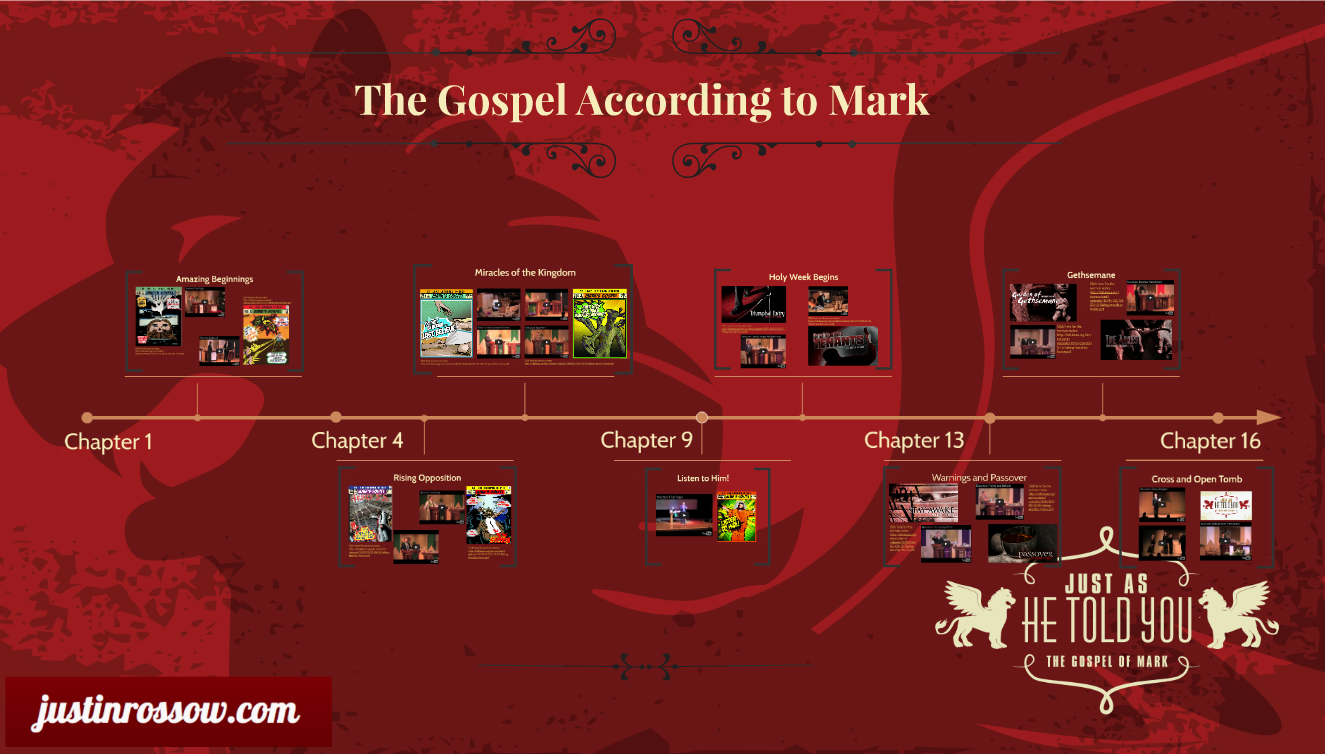
You can check out any of these sermons in the Prezi below. If you listen to several, you may notice that the dynamics of metaphor theory for preaching–Evoke the Source, Map to the Target, Test the Limits, and See Through a New Lens–are present within many of the sermons as I develop a moment of meditation.

But the STRUCTURE of these sermons order these moments of meditation, giving shape and direction to the progression of the sermon as a whole.

Instead of trying to do the same thing every week, these sermon structures allow me to preach both Law and Gospel in unique ways which flow from the unique texts I am preaching on–even when all of those texts are from the same Gospel!

If your preaching feels a little stale, check out different ways to Structure and Develop your sermons. It works for me!!

Mark Overview