8 Comments

The Secret Code Prayer

Have you ever run a discipleship experiment? When was the last time you tried something new related to following Jesus or being shaped by him?

I think a spirit of adventure and discovery goes a long way in the life of a follower. Not everything you try will be right for you, or right for this season of your life; but the willingness to try something even if you don’t know it will work is a real benefit for people who are led by the Spirit and want to keep in step with the Spirit.

Whether you like tying new things, or you would like to get better at trying new things, I’ve got just the thing for you! The stakes are super low; if it fails, who cares? And if it works, the benefit is real.

VF+logo+color+sized+for+vinyl+bannerI got to sit down with my friend Valerie this week and I asked her for some experiments I could run in my life of prayer. Valerie is the Educational Development Consultant at Visual Faith, and I know and trust her stuff. I’ve even worked with her before; she did the amazing draft sketches for my video on “Synod” as “Walking With.”

I know her and trust her, so it was easy for me to ask for help.

I think that is already the first takeaway: find help. You don’t have to wait until you are in crisis to seek support or encouragement or training or just another tool in your discipleship bag. We follow Jesus better when we follow him together. Ask someone you trust for one idea, one thing they do that helps them take a next step following Jesus.

Then try it out; run an experiment. It will probably seem uncomfortable the first couple of times. Give it a chance. And then, if it’s not for you, no harm done; stick it in a file to pull out some time when you are desperate. Sometimes a different season will make a specific method more helpful than at other times.

If you try it and love it, however, find a way to integrate that practice into your following Jesus toolbox; then ask for something new to try. The adventure of discovering new things the Spirit is giving you has no end; not here, not even in eternity. Ask. Seek. Knock. Experiment, and it will be given unto you…

So I was asking and seeking and knocking because I wanted a new experiment or two, and my friend Valerie came through; no surprise there. I am working on an Advent/Christmas Discipleship Travel Log–kind of an Advent Devotional on discipleship steroids–and I want that resource to give people new ways of doing the same old Advent Devotional stuff. I had a few ideas, but I wanted more. And I discovered that I didn’t need these experiments just for the project I am working on; I needed them for me. Am I glad I asked for help!

The first tool Valerie gave me she calls, “The Secret Code Prayer.” She gave me a couple of others, as well, but I started my mad scientist discipleship experiments with this one.

Valerie uses 4 x 6 cards of graph paper to do The Secret Code Prayer; the first time I tried it, I just drew my own, but the graph paper did help.

The directions are simple:

1) set a timer for five minutes, and then

2) proceed to write out a prayer as you pray, one letter at a time.

Choose all UPPER CASE or all lower case, don’t add spaces between words or punctuation, and don’t worry about spelling. It’s not a race, and in five minutes, you should not expect to get all the way through the card, and that’s OK.

When the timer goes off,

3) finish your thought, add an amen and stop.

(I found it helpful to go back and pray through the whole prayer again from the beginning a couple of times, but that’s extra credit and not part of Valerie’s original instructions.)

She calls it the “Secret Code Prayer” because of the way the letters all flow together and the words wrap to the next line: the effect looks like a garbled code you would have to break to understand. In fact, Valerie noted that, because the prayer is so hard to read at a glace, you gain a certain amount of privacy even in a group. But the practice of the Secret Code Prayer is designed to be an individual exercise, even when someone is sitting next to you and filling out their own Secret Code 4 x 6 card.

In my own experiments, I noticed some of the same things Valerie said would be helpful. Try it yourself and see what you think. Then share your experience; I’d love to hear how it went for you!

I found that writing the letters one by one made my mind slow down. That seems to be one of Valerie’s primary goals in all the resources she develops: she wants to slow our active brains down and focus our thoughts.

Instead of jumping ahead to the next petition in my head or getting distracted by my list of Things I Should Really Be Doing Right Now Instead of Wasting Time Like This (I hate that list), I found it was easy to stay focused on what I was saying to God. Even when I went back and reread the prayer a second time, it was difficult enough to piece together the words and sentences that I couldn’t rush through it like I so naturally do with prayers that are easy to read out loud.

Your mind works faster than you can possibly talk or even read silently, so it’s natural for your thinking to outpace the words you pray. But when my brain had to worry about one letter at a time, I had to focus my thoughts and move slowly.

In prayer, focusing your thoughts and moving slowly are both an advantage. But in a culture that thrives on speed and distraction, we are not trained to value moving slowly or being focused. I think the natural habits encouraged by our culture make a tool like the Secret Code Prayer really important. We need help to overcome the speed and distraction that permeates our daily lives.
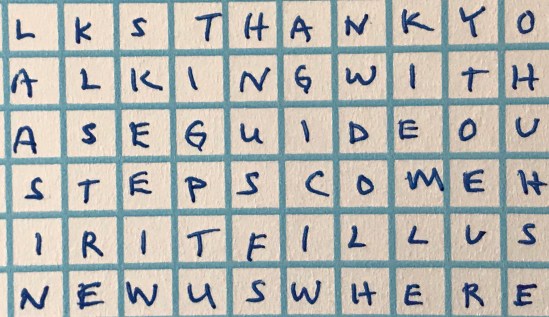
img_4285

In my own experiment, I also discovered that my prayer vocabulary changed when I used the Secret Code Prayer. I am not typically flowery or effusive in prayer, but there are some churchy kind of vocabulary words that sneak into your prayer life unnoticed, even if you know a polished prayer with fancy vocab doesn’t get you any extra credit.

Now, I appreciate both polished prayers and fancy vocab, but it also felt right and natural and real to pray in words that were short (and that I could spell). It’s amazing how fast you start filtering out pious phrases or complex sentences! This thing is taking forever, man! I’m not going to waste effort on a complicated thought with high scoring Scrabble words! Short, sweet, and  honest; that’s the way to go! And I’m not going to “implore” or “entreat” or “beseech;” I’m just gonna say “please”…

So my prayers were more focused and I took more time actually thinking about (and meaning) what I was praying. The five minutes went by quickly, and I had plenty to say in that time. And my prayers were noticeably more straightforward with God, simple in a good way, and direct.

All in all, I think the experiment was a success, and The Secret Code Prayer will make the Advent/Christmas Discipleship Travel Log! But more importantly, I am going to put that tool in my regular rotation of prayer.

OK; hold on one second.  “Regular rotation of prayer” kind of sounds like I have an awesome and diverse system of intentional methods for experiencing variety, energy, and excitement in my walk with Jesus. I don’t. But I want to. So while my “regular rotation” is feeble and inconsistent and awkward, and I am still adding The Secret Code Prayer to the short list of things I am trying to collect to help me figure out how not to be such an incompetent follower. This discipleship walk is marked by ups and downs and seasons of growth and seasons of lying fallow. I don’t want you to feel pressure to have an awesome and diverse system of intentional methods for your walk with Jesus; and I do think Jesus is extending you and me both an invitation to experience variety, energy, and excitement in our walk with him, and having a diverse system, of intentional methods will help with that.

The task of running an experiment is not supposed to be a burden or a guilt trip; this is supposed to be fun! So take a deep breath. You aren’t alone in having a really feeble prayer life. You are loved and forgiven and valued, already now, just as you are. And the Spirit invites you to come play!

What new prayer life playground equipment will you try out to see if it adds delight to your relationship with God? I’m going to spend some more time with The Secret Code Prayer, over by the swings. It was a real help, though it took some getting used to. And I would never have discovered this new tool for my faith journey if I hadn’t asked for help even when I wasn’t in crisis.

Thanks, Valerie! I follow Jesus a little more closely, and I receive from the Spirit a little more fully, and I trust the Father a little more securely because I know you.

Who can you ask for help, before you need it? What experiment can you run to add depth to your faith experience? What next step is Jesus shaping in you?

Try the Secret Code Prayer; maybe you’ll find it helpful! Or maybe you won’t. And that’s OK, too; find something else and try that. Delight is one of the marks of a disciple; find something fun to do in prayer, and see what happens next!



10 Comments

A Place to Call Home

My sister moved this last week, and I got to help just a little. She and her family had been living in the same farm house my grandfather was born in, the same place I spent Thanksgiving, and Christmas, and Easter (and Labor Day and Memorial Day) almost every year growing up. A bedroom set from my great-grandparents needed to be moved into storage, and I was willing and able. I wish I could have helped more…

It was really great to be back at the farm one last time; to see the cornfields and the woods; to smell the farm dust in the garage that brings back so many memories. How is it that the dust of a place can smell so unique? I’m not sure, but opening up that door to the garage brought back all kinds of memories: wooden baseball bats and old leather gloves, a Duncan Donuts® Frisbee™ and a fiberglass bow,  a forbidden workbench and a classic croquet set.

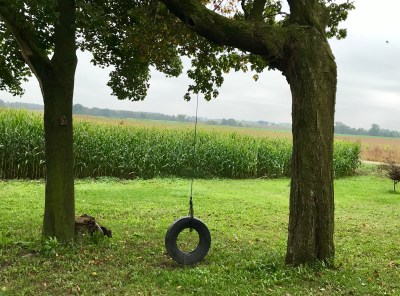
What a strange feeling to come home to a place that has changed so much! The tire swing is still there, though the rope and the tire have both been replaced, part of the tree is dead, and the rows of grape irises that used to perfume the air while we played have long since reverted to lawn. The kitchen window that overlooks the tire swing is still there, and although the window was upgraded years ago and the white lace curtains with bright red strawberries moved out in the 1980’s, I can still see Grandma at the window and hear her voice calling us in to eat.

The whole house is like that: home, but not home. The same place I know and love and hold in my heart, but not the same.

Returning to the family farm awakens a deep longing in me and powerful memories of what once was. The corner where Grandpa’s recliner always sat is now empty; the stove where I remember my great-grandmother sautéing asparagus (that grew among the grape irises by the tire swing) with breadcrumbs and butter in a large iron skillet—that stove has been replaced, and in fact the whole wall is gone; the old barn, if left to its own devices, with likely fall down in a few years, as the granary did a few years back; for now, you can still read my family name in weathered letters above the broad barn doors.

Home, my home; but not the same, not what I remembered—though exactly what I remembered, just not the same…

A few days before I made what could be my last visit to the family homestead, I got to take my college freshman on a field trip to Eastern Market, downtown Detroit. Her class is studying Detroit City history, so we got some information on the neighborhoods that used to cover what is now a combination of highways and Ford Field (Go, Lions!).

So much history, so much change from the time when greats like Louis Armstrong, and Ella Fitzgerald, and Dizzy Gillespie, and Ethel Waters performed in local Paradise Valley theaters, and the African American families who had come north for work in the automotive industry mixed with the whites in nightclubs and music halls before the race riots of 1943.

To stand on an overpass and take a picture (selfies are now assigned by college professors, it turns out) and to see the football stadium and lanes of highway where houses and music halls once stood is to remember home, a place of belonging that doesn’t exist anymore, a history we can access by standing on that same ground and remembering what once was. Home, but not the same; the same place, but changed.
Those experiences of simultaneous homecoming and displacement remind me of a theme that runs throughout Scripture. From the time Adam and Eve left the Paradise Mountain that was Eden, we—their heirs—have been longing to get back home. And we catch glimpses of being home, with God, in the Land; but it’s not quite the same. More than once in the history of God’s people, we get back home only to find that the place is less than perfect, and the people leave something to be desired. And, soon enough, our sin brings another wave of exile. And God’s grace once again calls us back and invites us home.

Peter writes his first letter to “God’s elect” (that’s us), but he also calls them (that’s us) “exiles” and “sojourners,” strangers and foreigners in this world. Paul also tells us “our citizenship is in heaven, and we eagerly await a savior from there.” We are not at home in this world the way God intended us to be.

But before we all start singing, “Heaven is my home,” let’s remember that the Paradise God created as a place for Adam and Even to call home and live in his presence was not some non-physical dimension populated by angels and spirits. Adam and Eve (and you and I) were created as spiritual/physical beings placed in a physical Garden where God himself dwelt by his Spirit. This physical creation is our home, the home we are longing for: just not the way it was, not the way it’s supposed to be, not the way it is going to be.

It’s like the longing I felt visiting the family farm, a pining for what was, except in this case, it is just as much a longing for what will be. The fond memories of a place to really belong are not just a way of looking back to how life used to be; we look forward to a time when it will be that way again.

Our citizenship, Paul says, is in heaven; and we eagerly await a savior from there, even the Lord Jesus, who will make our lowly bodies to be like his heavenly body. That doesn’t merely mean he will take us to a spiritual place without physical bodies or physical existence (he’ll do that, too, but the interim between death and resurrection is not our final destination). What Paul is talking about is the full hope of the story arc of Scripture: the Day of the Lord, when God will restore both our bodies and our home, so that in resurrection bodies we might enjoy the New Creation, a physical existence even better than Eden, because this time around the Creation will bear the marks of the crucified and risen Jesus.

We long for something past, but even more, for something future. This is our home, but not the home it used to be; and even more, not yet the home it will be again. We are foreigners and sojourners, but foreigners and sojourners who are already living in the Land of Promise, just not the way it is going to be when the Land of Promise is ours the way God fully intends.

In that sense, I think Abraham is a great example of our longing for a future home. Abraham received a promise from God, and Abraham believed God’s promise. God said, “Go!” and Abraham went. Abraham was a foreigner and alien and sojourner… but the place of his wandering was already the Land of Promise. The Land was his, but only by faith; he was a foreigner in his own country. He was home, but not yet home; and he longed not merely for the past but for the future fulfillment of the promise.

img_4238I may not have an excuse to go back to the family farm ever again. My memories of the farm will endure, though they will never be as strong as when I stand on that particular plot of land. I remember that place and those people with longing: not just longing for the past, but longing for the future. The barn will rot; the tire swing will decay; the old farm house will not stand forever.

But the Grandpa who always sat in that corner, the Grandma who called to me out of that window, the Great-grandmother who fried asparagus in the kitchen, and who taught me to play euchre, and who sat in her rocker by the front window and let me jump over her cane—those people I remember and love and long for will one day stand again, not on that old farmland, but in the New Creation.

And I ache, and weep, and long for that day.

Come quickly, Lord; I need a place to call Home.


3 Comments

I’m Not So Sure About Certainty

Certainty is kind of a tricky thing.

I mean, there are some Bible passages that seem to make certainty something we all should not only strive for, but already have in spades. The flagship verse for certainty is probably Hebrews 11:1.

Now faith is confidence in what we hope for and assurance about what we do not see. (Hebrews 11:1, NIV)

(I have to admit, in my own memory that verse reads slightly differently, something closer to: “Faith is being certain about what we hope for and sure of what we do not see.” The change is subtle, but perhaps significant. I wonder if we have, in our collective North American Church subconscious, slightly shifted the meaning of these words to align more with a Modern logical positivism. Your own culture always affects how you read Scripture, and it is hard to notice, let alone be free from, those kinds of cultural filters.)

Faith, it seems to me, gets equated with certainty; and if you are not sure, you must not believe. We don’t leave much room for doubt in the lives of people who have faith. Look at Doubting Thomas: he often gets almost as bum a rap as Judas. Doubt is treated as something of a taboo, the opposite of faith.

And to some extent, I get it: I mean, I want to have confidence, and trust, and assurance about my faith and my Jesus. And while “certainty” feels like one step farther down the path than “confidence,” I can see why it appears to be on the same path. Why wouldn’t we want people to be certain about their faith?

Maybe that’s the problem: maybe the problem with certainty is when it becomes a way of measuring or evaluating faith, ours or others’. The problem with looking directly at your faith to measure your faith is that you can always get another layer deeper in your analysis: “Do I believe … ? Yes, but do I really believe … ? Yes, but do I really, really believe … ?”

Faith doesn’t turn towards itself for analysis; faith turns to Jesus. I think confidence and assurance work the same way. If I want to know if I am certain–really, truly certain–there will always be one more layer to the onion. “Are you sure … ? Yes, but are you really sure … ? Yes, but are you certain that you are really sure …?”

My confidence is not in my confidence, and I don’t take assurance from my certainty. Rather, the object of both my faith and my certainty is Jesus. Let him be true, and even my own heart false, and I will still trust he has me. Even when I doubt.

I resonate with the father in Mark 9, who cries out with tears:

Lord, I believe; help thou mine unbelief! (Mark 9:24, KJV)

(It just sounds cooler in the King James …)

That’s a man whose faith is mixed with doubt, but he doesn’t let that keep him from clinging to Jesus. That father came looking for Jesus somewhat desperately on behalf of his son. The followers of this Jesus had already failed miserably. When Jesus finally shows up, this man asks Jesus for any possible help he may or may not be able to give. He asks with little hope or confidence, but in profound dependence and need.

When confronted with the feeble character of his request and the weakness of his faith, this man doesn’t turn away. He doubles down on Jesus. “If you can …” turns into, “Lord, I believe; but I need your help, because I also don’t believe at the same time.”

If you were grading that man’s faith based on Hebrews 11, he probably wouldn’t pass. D- at best. The problem is not, I think, with Hebrews 11, but with using Hebrews 11 to “grade” anyone’s faith. Since when did “certainty” become the measuring stick we use to distinguish those who “believe” from those who don’t?

Another one of my favorite scenes comes early in the Gospel of John. Philip gets to know Jesus, and goes and tells his friend Nathanael: “We have found the one Moses wrote about in the Law, and about whom the prophets also wrote—Jesus of Nazareth, the son of Joseph.” Nate’s response is not exactly a hallmark of faithfulness.

 “Nazareth! Can anything good come from there?” (John 2:46, NIV)

But Flip doesn’t chastise Nate for his lack of faith; Flip doesn’t even defend his own faith, or give all the logical positivist reasons for why his faith is right and Nathanael’s doubt is wrong. Instead, Philip does something I think we all can learn from in our age of skepticism and doubt: Philip extends an invitation.

Philip practices hospitality, not apologetics. “Come and see,” Philip says. And getting to know Jesus changes Nate’s worldview. Philip didn’t beat Nathanael up over his lack of faith; Flip brought Nate to Jesus.

I think our current cultural setting requires us to be comfortable around people who have their doubts. And that may mean being comfortable with our own doubts, as well. Your faith in Jesus doesn’t have to be perfect in order for it to be true. Just like faith, certainty is a gift from God, worked by the power of the Holy Spirit. When you are certain, thank God for that gift; when you struggle or doubt, lean on the Spirit of Jesus to strengthen and console.

Maybe owning up to the weakness of our own faith will not only make us more dependent on Jesus, but more open to walking with other people who aren’t so sure they believe. And they are out there. All over the place. And they desperately need to find people who accept their doubt along with their faith so they can take a next step following Jesus.Not Sure

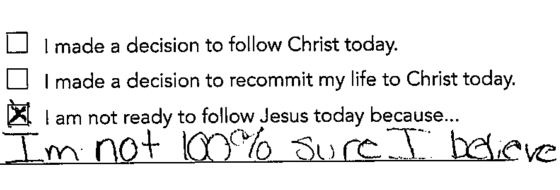
I recently read a newsletter a friend forwarded to me; it was about a youth event in a large US city. The organizers provided a way for the youth to make a commitment toward life change at the event. They used language I probably wouldn’t have used for the ask (looking at your decision is like looking at your faith or your certainty: “Did you decide … ? Yes, but did you really decide … ? Yes, but did you really, really decide … ?”), but what caught my eye was the third option you could check: “I am not ready to follow Jesus today because …”

One teenage girl checked that box and wrote on the line provided the reason she is not ready to follow Jesus today: “I’m not 100% sure I believe.”

And that’s why I’m just not so sure about certainty: it gives the impression to real people in the midst of real struggles, that unless you are 100% sure, you can’t follow Jesus, you can’t take a step forward in faith, you don’t belong to our club, you’re not in the Kingdom.

Coming out of an Age where the only things that were real or true were the ones you could objectively prove mathematically or by scientific experimentation, and coming to terms with an Age where even science and math will tell you there is no such thing as an objective viewpoint, the Church needs to be able to deal graciously with people who aren’t sure. It has to be OK to have doubts. We need a new liturgical prayer, “Lord, I believe; help thou mine unbelief.”

I think that teenage girl who isn’t 100% sure she believes is the kind of worshiper the Father seeks, one who worships in Spirit and in truth; not in some objective, abstract, disembodied Truth, but in the Truth who is a Person; the person of Jesus, who heard a father’s cry, and helped him overcome his unbelief, and healed his son.

My friend Doubting Thomas actually deserves all the bad press he gets, because the word we usually translate as “doubt” is in point of fact much worse. The opposite of faith isn’t doubt; faith and doubt exist together (Lord, I believe; help thou mine unbelief!). The opposite of faith is unfaith, the absolute refusal to believe, no matter what. 

We should actually call him “I Refuse to Believe” Thomas. (Not as catchy, I know.)  Thomas gives doubt a bad name. This isn’t weak faith, or little faith, or faith mixed with doubt: this is UN-faith. In fact, Thomas expresses a kind of certainty: Thomas has no doubt about his unbelief.

“Unless I see in his hands the mark of the nails, and place my finger into the mark of the nails, and place my hand into his side, I will never believe.” (John 20:25, ESV)

And we tend to treat the 17-year-old girl who isn’t 100% sure, as if she had made Thomas’s faith commitment: “I will never believe … !”

“I Refuse to Believe” Thomas is way worse than a Thomas who has faith mixed with doubt. And yet–! And yet even Unbelieving Thomas, who at that moment probably is outside of the Kingdom, is not outside of the faithfulness of Jesus to bring him home.

Jesus shows up again, even to Thomas who has made a confident commitment to unbelief. “Here Thomas! Put your fingers in my nail marks! Put your hand in my side!” And I think we do a disservice to all who have ever doubted, even a little, when we get the next verse wrong. Jesus does not say, “Stop doubting…” Jesus says, “Give up your commitment to unbelief, and start again to believe!”

I don’t know if I can stop doubting. I don’t know how capable I am even to give up my commitment to unbelief. But I trust that I have a Jesus who shows up and makes himself available to those who are not 100% sure.

Jesus’ final words to Thomas are actually intended for us:

“Because you have seen me, you have believed; blessed are those who have not seen and yet have believed.” (John 20:29, NIV)

Blessed are those who have not seen, and yet believe. Faith is having an assurance of things not seen. Maybe that’s like, “when I am weak, then I am strong …” A kind of paradox of our faith: seeing isn’t believing, believing is believing (even when you aren’t 100% sure).

So I’m not so sure about certainty, at least when it becomes a grading scale for your faith. As we do with so many gifts from God, we can turn certainty from a gift into a burden. But the certainty, assurance, confidence of your faith is not a burden to carry; if the certainty is a measuring stick, your faith will never measure up. (Yes, but are you certain that you are sure?)

Instead, certainty is a gift and a delight. Enjoy it. Seek it. And when your faith seems less than certain, don’t try harder to make yourself more sure. Instead, turn to Jesus and pray, “Lord, I believe; help!”

And if you meet a teenage girl who isn’t sure she believes, don’t try and convince her that you are right and she is wrong; instead, extend an invitation to the presence of Jesus, and let him figure it out.

And if one of your closest friends has made a faith commitment, “I refuse to believe,” don’t give up on him. Instead, just keep hanging out together, living life together, spending time together. For some strange reason Unbelieving Thomas was back in that Upper room the following week. Don’t reject your friend because of his doubt, or even because of his unfaith. Do keep looking for Jesus to show up.

Can I tell you a secret? I’m not 100% sure I believe. But I trust that Jesus will deal with me by the power of his Spirit. I trust that Jesus accepts me as I am and invites me to keep following. I trust that his faithfulness is stronger than my doubt. To me, that’s real certainty; the assurance of things I can’t see, I don’t see, I’m not supposed to be able to see yet, which is why I still need my faith.

My faith may be feeble; it may even be mixed with doubt at times. But you should see the guy I have faith in! His faithfulness is certain! (What a relief!!)

Leave a comment

A Loving God with Dirty Hands

Your Heavenly Father rejects a remote control approach to your discipleship walk. You know: God way up there somewhere, pushing some buttons or pulling a few levers behind the curtain to make things happen in your life. Instead, in the person and work of Jesus, God rolls up metaphorical sleeves, puts on an artist’s smock, dips those divine fingers in the water, and engages your life the way a potter engages the lump of clay spinning on his wheel.

If you ever get a chance to see a potter shaping and molding clay—whether in person or on YouTube—watch the potter’s eyes! As that potter shapes and molds, her full attention is on what she is doing, on the pot she is starting to form. If the potter dares do something drastic—and I have seen potters take take a piece of wire or even a fork to use on their clay—if the potter does something unusual or unexpected, she doesn’t do it with her head turned, looking in the other direction! Instead, she focuses her full concentration and energy on the pot while she shapes and molds the clay. When the shaping gets most dramatic or difficult or sensitive, that’s when the potter is more engaged than ever.

As you go through something in your life that is causing you to be shaped and molded—and for the clay, that’s always uncomfortable!—when God allows something difficult in your life, and then uses that difficulty to make you look more like Jesus, you can trust that your heavenly Potter hasn’t abandoned you. It’s not that God is absent from your life and therefore difficult things are happening. No! In the difficult things God’s eyes and heart are focused on you more than ever! Pots get special attention when the sculpting is most drastic. When your life feels like it’s spinning out of control, divine eyes and divine hands are focused on you. You have a loving God with dirty hands.

Dirty HandsThat’s what the message of the incarnation is all about. As God shapes and molds the lives of real people, God ends up with dirty hands. Jesus was born of the Virgin Mary, just like you and I were born; in the same, messy way. And his dad probably wiped him off and picked him up by the feet and spanked him on the butt to make him cry. He came into the world just like you and I did.
Jesus walked–that’s what he did! He didn’t have an angel chariot that whisked him wherever he wanted to go! He didn’t even have a bike. Jesus walked everywhere he went, and his feet got dirty, and his legs got tired, and he got hungry; even, at times, exhausted.

Jesus knows what it’s like to bury a father; Jesus knows what it’s like to stand at the graveside of a friend and weep; Jesus knows what it’s like to be betrayed by someone you trusted. Jesus was willing to get his hands dirty.

Jesus got his hands dirty when he touched a woman who was ceremonially unclean because of an illness she had carried in her body for years; Jesus got his hands dirty when he made mud and put it on the eyes of a man born blind, in order to heal him. Jesus got his hands dirty when he knelt down and washed his disciples’ feet; Jesus got his hands dirty when he let Roman soldiers nail them to the rough wood of a cross.

God was not willing to play remote control with your discipleship walk from a distance. God rolled up potter’s sleeves and, in Jesus, touched your life to mold you and shape you in love. You have a loving God with dirty hands.

Whatever you are facing this week, you can trust the God who is willing to have a potter’s dirty hands. You can pray with the Psalmist: “Your steadfast love, O Lord, endures forever; do not forsake the work of your hands!” (Psalm 138:8)

2 Comments

V6 Discipleship: Social Influence (Part 2 of 3)

V6 Discipleship: Social Influence (Part 2 of 3)

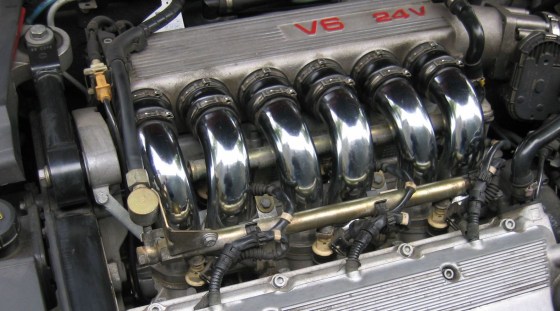
This three-part article is looking at six sources that influence change, for better or worse. Research has shown that the more of these sources are functioning at the same time, the more likely you will be propelled forward on your journey (see VitalSmarts Influencer training for more in depth theory). That’s why I like to think of these six sources of influence as a V6 engine: if you can get all six cylinders firing at the same time, you’ll really have momentum!

V6All change—discipleship or otherwise—requires both motivation and ability. You have to want to do it, and you have to be able to do it. In Part 1, we looked at personal factors that influence your motivation and ability. But personal factors are only two of the six cylinders! Social factors can also influence your behavior.

And it’s a good thing, too! I was telling you about my friend who lost some weight and managed to keep it off with real life change. But when he started, he didn’t have with personal motivation or personal ability.

Discipleship can be like that: you can want to change, but not really want to do what’s necessary for change, or not even know how to do it! Don’t throw in the towel. Let’s look at how Social Motivation and Social Ability can help you move forward on this journey of faith.

V3 and V4

So my friend knew he needed to change, but he didn’t want to change and he didn’t know how to change. He needed help. (Don’t we all?)

The third cylinder of our V6 change engine is Social Motivation. These are the people and relationships that help you want to do the kind of things that bring positive change. I like to think of this source of influence as Your Cheering Section, the people in your life who help motivate the right kind of habits and behaviors.

Once my buddy made the decision to change, he needed people to cheer him on. In this case, his wife was also on board with losing weight and getting a little healthier. That’s a huge plus. When you interact with someone you care about daily, and they encourage the change you want, and they want the same change, it starts feeling like you have somebody on your team.

Again, discipleship is like that. Discipleship is a team sport. We follow Jesus better when we follow him together, for lots of reasons. Encouragement, support, sharing burdens, forgiving sins, speaking truth in love, listening with compassion—all of those elements of discipling relationships fit in this third cylinder of Social Motivation. (Check out We Are the Coals for another take on the importance of mutual encouragement on your faith journey.)

But all the encouragement in the world won’t bring about change unless you also know what to do: change takes motivation and ability. So the fourth cylinder of our V6 change engine is Social Ability and includes all the ways relationships help increase your knowhow.

Reddit logoWhen my friend went to lose weight, he knew he had to pay attention to what he ate, but he didn’t know what tool in the diet bag would be a good fit for his family. He told me about some of the conversations he had with friends at work who were fired up about different kinds of diet plans that involved everything from no carbs to balancing fat intake to eating kale three times a day… But ultimately he used Reddit to get this Social Ability cylinder up and running.

Reddit is a group of online communities organized around interest areas. These interest groups, or Subreddits, discuss specific topics, and the quality of the content and the kinds of answers that get seen most are determined by the group itself. You don’t have to add your two cents to the discussion to follow along, and my friend checked out some Subreddits on losing weight just to get a handle on all of the information out there.

Although those communities were online, they functioned in the Social Ability cylinder; they helped move the needle on my friend’s own Personal Ability when it came to losing weight. Based on what he read, he chose a kind of intermittent fasting as a primary tool on his utility belt for losing weight. He doesn’t eat or drink anything but water or black coffee between 7:00PM and 11:00AM. Cutting back on late night snacking and a free doughnut in the morning workroom of course cuts down on calorie intake, but there are other benefits as well. (I’ll let you explore Reddit if you are interested in learning more…)

The point is, my buddy didn’t have the Personal Motivation or the Personal Ability to lose weight, so he found a way to affect both of those areas through relationships. His relationship with his wife brought significant and daily encouragement to the change he was trying to effect: she is definitely in his Cheering Section! And the internet provided a community of specific shared knowledge that, with some trial and error, allowed him to gain skills he had never had before. That’s why I think of this fourth cylinder as Your Reference Section: it’s the place you can go to learn how to do what you need to do from people who are already doing it.

car need help smallerIs there an aspect of your faith walk that really needs an upgrade? Is there an area of your relationship with Jesus that is really exciting right now, and you want to build momentum? Is there a next step you feel the Spirit is inviting you to take on this journey? To take even a small step, you will need Personal Motivation and Personal Ability.

But that’s only one small part of the equation. We follow Jesus better when we follow him together. You’re going to need people on this journey with you, people who will encourage you and cheer you on and pick you up when you fall down. And you will need people who know something you don’t, people who can help you experiment with and learn new ways of growing and new tools for change.

Can you think of people like that in your life? Who’s in your Cheering Section? What kind of help do you get from your Reference Section? Who are the people that increase your ability or your motivation to take a next step following Jesus?

If you have all four of these cylinders firing together, you are well on your way to positive change in your discipleship walk. But wait! This is a V6 discipleship engine! In Part 3 we’ll look at how your motivation and ability can be affected by other external factors. The more cylinders you have firing together, the more inevitable the change will be!

4 Comments

We Are The Coals

As Paul begins his second letter to Timothy, he makes reference to Timothy’s living faith:

I am reminded of your sincere faith, which first lived in your grandmother Lois and in your mother Eunice and, I am persuaded, now lives in you also. For this reason I remind you to fan into flame the gift of God, which is in you through the laying on of my hands. (2 Timothy 1:5-6, NIV)

Paul seems to think that faith is a living thing that gets passed on from generation to generation. Passing on a living faith isn’t restricted to families: Paul even says the gift (I think he must be referring to Timothy’s faith at least, though “the gift” could be broader than just faith)—Paul says the gift came to Timothy through Paul’s ministry. But family certainly plays a primary role.  Grandma Lois is involved; Mother Eunice is involved; and Paul (adopted “faith father”? He calls Timothy “my child,” in verse 1) Paul is also involved in passing down a living faith to Timothy.

This faith that lived in Louis, and in Eunice, and in Paul now lives in Timothy, too; so Paul encourages his young friend to “fan into flame” this gift that now dwells in him.

That’s a really interesting image for a living faith, a faith handed down from one generation to the next.

“Fan into flame.” The Greek verb Paul uses shows up only here in the New Testament. The verb is anazōpuréo and it comes from three distinct Greek words:

“Ana-” as a prefix means “up, anew, over again;” “zō” is a contracted form of the Greek word for “life” or “living thing” (maybe you know the name Zoe means “life”); and “pur” which means “fire.”

Ana + zō + pur = anazōpuréo: to enliven the fire anew; to rekindle the spark; to fan into flame.

What a wonderful image for faith! A living fire that dwelt in Grandma, and Mom, and Paul, and now Timothy—and Timothy is invited to fan that living fire into a flame!

I don’t think this is “passing down the faith” the way we usually imagine it. Typically, “passing the torch” means the people who have more knowledge or experience or faith transfer that knowledge/experience/faith to someone younger and less experienced. That kind “passing down” or “passing on” is always only in one direction, from the one who has more for the benefit of one who has less. And, whether it’s a baton or torch, you pass it on as quickly as possible and then it’s the next person’s turn to run with it…

But that’s not how Paul seems to be imagining this living faith. Paul already said, one verse earlier, how much he longs to see Timothy again, not so he can transfer some more knowledge or experience onto Timothy, but so Paul’s joy might increase. It kind of reminds me of what Paul says elsewhere to some other friends:

I long to see you so that I may impart to you some spiritual gift to make you strong—that is, that you and I may be mutually encouraged by each other’s faith.
(Romans 1:11-12, NIV)

Faith is a fire that spreads from person to person, but it’s not exactly a torch that gets passed down. I think faith works more like charcoal.

You know how a grill works: if you want to light the charcoal, you pile it all together because one coal that’s lit will light other coals. Put coals together and they will feed each other; take two live coals and separate them and they will go out. Just being in contact with other coals that are hot will increase the heat for all the coals involved.

ash-barbecue-black-1309072Faith is like that. Faith is a living thing. When Lois passed it on to Eunice, that wasn’t the end of their faith relationship; Timothy now has the gift of living faith in him through Paul’s ministry, but Paul can’t wait to be together again, so their mutual faith can stoke their individual faith.
When Paul encourages Timothy to fan his faith into flame, to rekindle the spark, that increase in faith isn’t supposed to happen in a vacuum. (Actually, flame can’t exist at all in a vacuum…) Part of Timothy’s work of fanning his faith into flame is to hang out with people like Paul; Timothy’s faith will rekindle as a result, but so will Paul’s. The last thing you want to do as a coal is to go it alone.

And yet “going it alone” is a real temptation we face as followers of Jesus, especially in a culture that teaches “rugged individualism” and self-sufficiency as lofty values we all should aspire to. Multiple times over the years, I have had people tell me something like, “I’m sorry we haven’t been to church in a while, pastor; we’re really going through a really difficult time. But when things get better, we’ll be back …”

I mean, I can see where they are coming from… When your world is upside down, sometimes you just don’t want to show up and face questions about how you’re doing. And if you go through a rough patch where even your faith seems cold and hard, showing up to worship can make you feel like a hypocrite.

But the thing is, a coal off on its own will naturally go out. What I need when I am hurting or anxious or troubled or full of doubt is not time away from other coals; what I need is someone’s living faith burning in close proximity to my cold and hard faith. Not only will I find a new sense of rekindling in my own faith, but their faith will end up burning even brighter.

We follow Jesus better when we follow him together. He designed us that way. We are mutually encouraged by each other’s faith.

Please don’t hear that as a burden; Jesus intends it as a joy. I know there are times when going back to the same place you have been worshiping, the same place that has perhaps even done damage to your faith or thrown water on your fire, may not actually be a Gospel invitation.

I trust that God works through fallen, sinful humans at fallen, sinful congregations (there aren’t any other kind, of people or congregations…). And I know that sometimes, for a time, in some circumstances, going back to your congregation would mean putting on a mask that you hate wearing and smiling at people who have deeply wounded you. Rekindling your faith may be impossible in that kind of a setting.

But you also can’t rekindle your faith on your own. You need people who follow Jesus to help you regain the joy of following Jesus. They don’t have to be the most experienced Jesus-followers. They don’t have to be semi-professional disciples. Any coal that’s a little white around the edges will help rekindle any other coal, given proximity and time.

The more it feels like things are too difficult to show up at church right now, the more you need somebody who loves Jesus to love you, too.

I wish I had a simple answer for how you find those people in your life. Because when you need those people the most, you have the least amount of energy to go out and look for them.

So maybe we have to start thinking about fanning faith into flame before we get too hard and cold and have no energy left for relationships. Maybe now is the time to start wondering, who is kindling my faith? And who’s faith am I rubbing off on? Which of the people in my address book could I send an email that read, “I long to see you, so that you and I may be mutually encouraged by each other’s faith?”

I have gone through regular cycles of having people who kindle my faith in close and regular proximity, and ending up all alone at the edge of the grill wondering where all the heat went. I have succeeded, and failed, and succeeded, and failed again at having relationships that help me follow Jesus.

But I know this: I have to keep fighting to find those burning coals in my life. As difficult as it can be to find them, as heart-breaking as it can be to lose them, there is no better way to follow Jesus than to follow him with another person who serves as a live coal touching your faith. We need people, even if they are fallen, sinful people—we don’t have access to any other kind.

If that feels a little daunting to you right now, you aren’t alone. Take heart in this: when it comes to increasing the flame, any coal can help any other coal. You don’t have to do something super-religious; you don’t even have to “get it right.” Mutual rekindling just takes proximity and time.

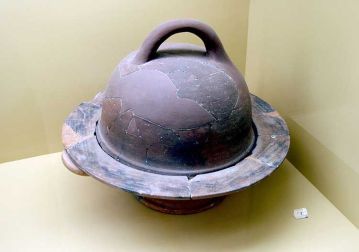
ancient Greek oven

An Ancient Greek Oven

Almost five hundred years before Paul, a Greek poet and playwright captured an image that I think gets 2 Timothy 1:6 exactly right. “The heavens are an oven,” he wrote—an ancient Greek bread oven looked kind of like a cake tray with a cover except made out of clay: you put the coals on the tray, put the domed cover over the try, and let the coal heat up the oven. So the earth is like the tray and the dome of the sky is like the covering of the oven…

“The heavens are an oven,” he wrote, “and this oven is around us; but we are the coals.”

“For this reason I remind you to fan into flame the gift of God, which is in you through the laying on of my hands.” 2 Timothy 1:6 (NIV)

Who can you burn a little closer to this week? You might both need the natural rekindling that takes place when the Spirit blows in the conversations of believers and fans their mutual faith into flame. Start asking that question now, and keep fighting to find those coals in your life. Mutual encouragement in the faith isn’t rocket science, but it does take proximity, and time.

Jesus wants to give you the gift of a rekindled faith. And the means he uses to stoke your fire are the people he places in your life. His is the Spirit, and that Spirit is around us; be we are the coals.


Photo Credit: Featured Image by Lukas from Pexels

2 Comments

V6 Discipleship: Personal Influence (Part 1 of 3)

V6 Discipleship: Personal Influence (Part 1 of 3)

A V6—that is, an engine with six cylinders—will unfailingly provide more power and more drive if all six cylinders are working together. Discipleship is kind of like that. Research has identified six distinct sources of influence that create the drive needed for change or growth. Knowing what those areas are, and getting all six cylinders up and running, will help propel you forward on your journey of faith.

I have a friend who recently dropped some significant weight. He’s even been able to keep the weight off with the kind of consistency that only comes from life change. As I listened to his story and asked some follow up questions, I was reminded of the research done by VitalSmarts and presented in their Influencer training. Their research suggests six distinct areas that enable (or hinder) change.

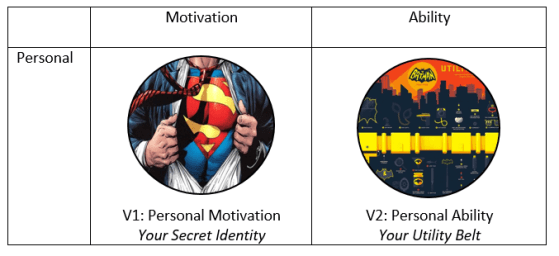
In order to make any significant or lasting change, like my friend did, you must have A) the desire to do it and B) the ability to do it. That much seems obvious. But VitalSmarts lays out six types of influence that affect either motivation or ability, three for each. I like to think of all these influences together as the cylinders in a V6 engine, an engine that propelled my friend into a healthier lifestyle and has the potential to drive both individual and congregational discipleship growth. Let’s look at all six cylinders, two at a time.V1 and V2The first set of driving factors has to do with your own personal motivation and personal ability. I like to talk about your Personal Motivation cylinder as your secret identity, the values you hold that define who you are and shape the choices you make on a daily basis. If you want to make a change, you will have to find a personal value that aligns with the change you seek.

Ironically, my friend felt almost no personal motivation to lose weight. He was happy and (kind of) healthy and had no personal desire for change in this area of his life. You might think that your own individual motivation is the key to any change, but actually, personal motivation is only one of the six cylinders. Maximizing the number of the cylinders firing together is far more important than any single source of influence by itself. As we shall see, once some of the other pistons started firing, my friend found some personal motivation. But he didn’t start there. And that’s a comfort for people like me, who don’t always feel an overwhelming personal desire for ongoing spiritual growth…

The counterpart to Personal Motivation is the Personal Ability cylinder.  (Remember, change takes both motivation and ability.) If personal motivation asks, “Do I want to?” personal ability asks, “Do I have that tool in my bag?” That’s why I think of this source of influence as my utility belt: Batman might want to climb out of the trap he’s in, but without the Batarang, he’d still be stuck in the Joker’s secret lair.

When my friend finally got to the point where he wanted to lose weight, he had to figure out how to do it. There are lots of tools available for counting calories or tracking exercise, and lots of eating plans to affect change: should he go with Atkins, Keto, South Beach, Paleo, Dukan, HCG??? He wasn’t born with that tool in his bag, and he didn’t come by it magically. He knew he needed to lose weight, but he didn’t really want to; and he didn’t really know how to.

Does that sound familiar? Have you ever thought it would be nice if you wanted to read the Bible more, or at least knew how to read more productively? Have you ever wished you felt like going to church more, or knew what to do once you were there?

V6 PortraitTake heart! Personal Motivation and Personal Ability are important, but they are only one third of the equation! The other four cylinders help get these two up and running. And once you get all six firing, positive, lasting change is all but inevitable!

We’ll get into how social influence can affect both Motivation and Ability in Part 2 of this V6 Discipleship blog. For now, keep reflecting on what small step Jesus might be inviting you to take next. Can you discern any change in your discipleship motivation or ability? Ask the Holy Spirit what he is up to in your life. (And don’t forget to look and listen for the answer!)


Featured Image credit: V6 photo by Rafal P. from FreeImages